Holistic and Classified Analysis of Variables and Criteria
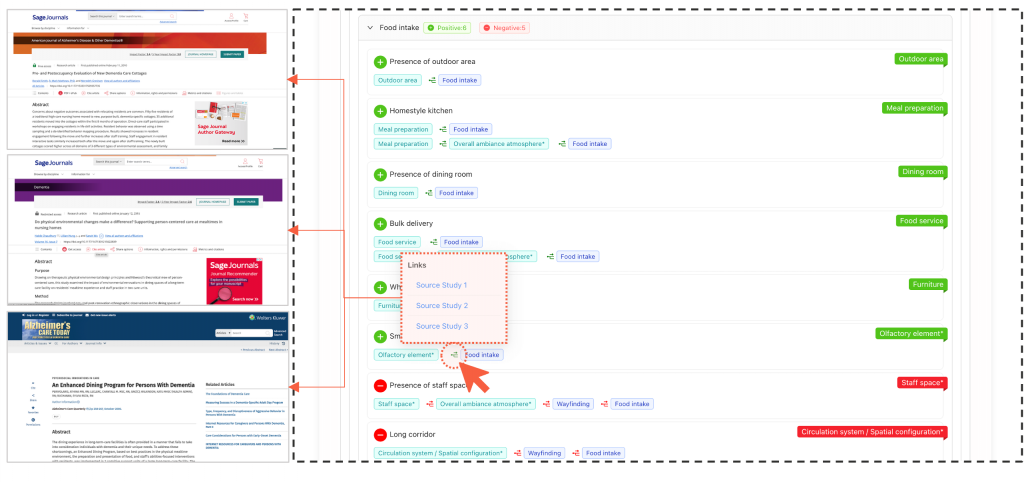
The assessment is based on the structured linkage of a multi-layered classification of architectural variables with defined health and care outcomes. On this basis, a formal model is established that maps spatial properties and health-related target metrics within a shared system logic. This creates a consistent reference framework in which both architectural features and health requirements are made comparable, traceable, and assessable.
The architectural variables include, among others, spatial geometry, materiality, lighting conditions, acoustics, air quality, and usage patterns. The health and care outcomes structure criteria across the domains of physical health, psychological well-being, and performance, along with their respective subcategories. This dual-sided classification enables a differentiated assessment that can be applied contextually to specific areas, user groups, and functional zones within a facility.
Cascade Analysis Through Linear and Non-Linear Interactions
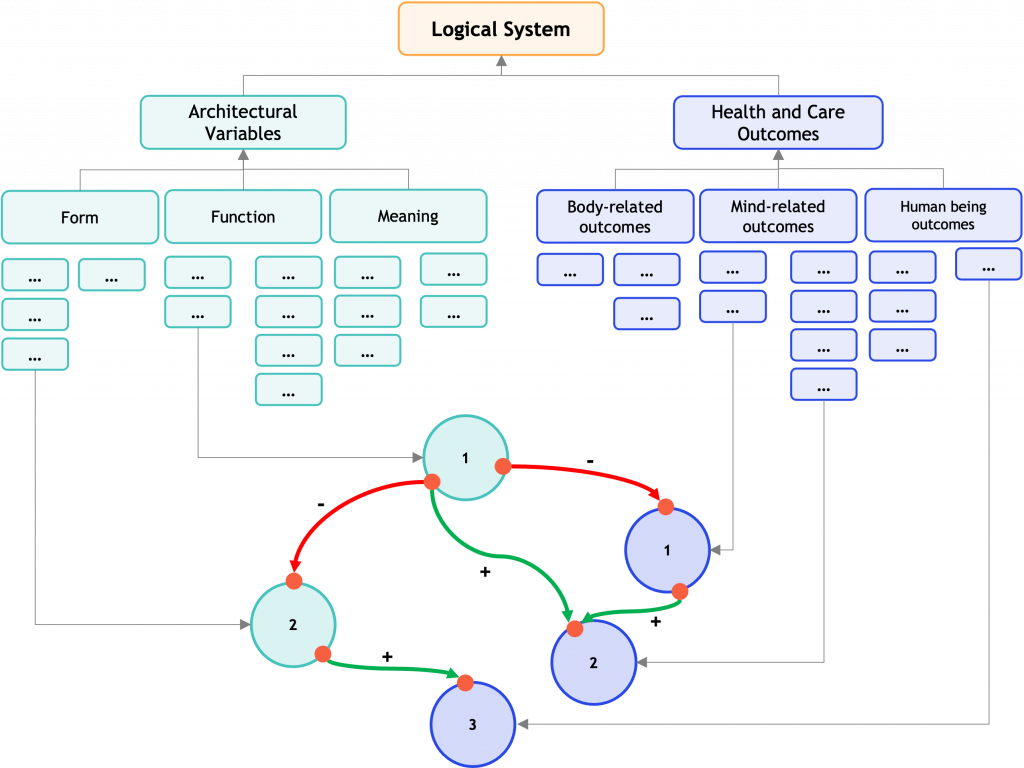
The assessment logic considers both direct and indirect impact pathways between architectural variables and health outcomes. Individual variables may act directly on a given criterion, while other effects arise through intermediate steps, for example through chains such as architectural variable → architectural variable → health outcome or architectural variable → health outcome → health outcome. This reflects the fact that spatial influences do not operate in isolation, but rather in interconnected relationships.
These linear and non-linear relationships are systematically modeled to capture combined, amplifying, or mitigating effects of multiple influencing factors. On this basis, assessment profiles are generated that make the dynamic interaction between spatial parameters and health-related criteria transparent and enable a well-founded prioritization of architectural measures.
Root-Cause and Gap Analyses
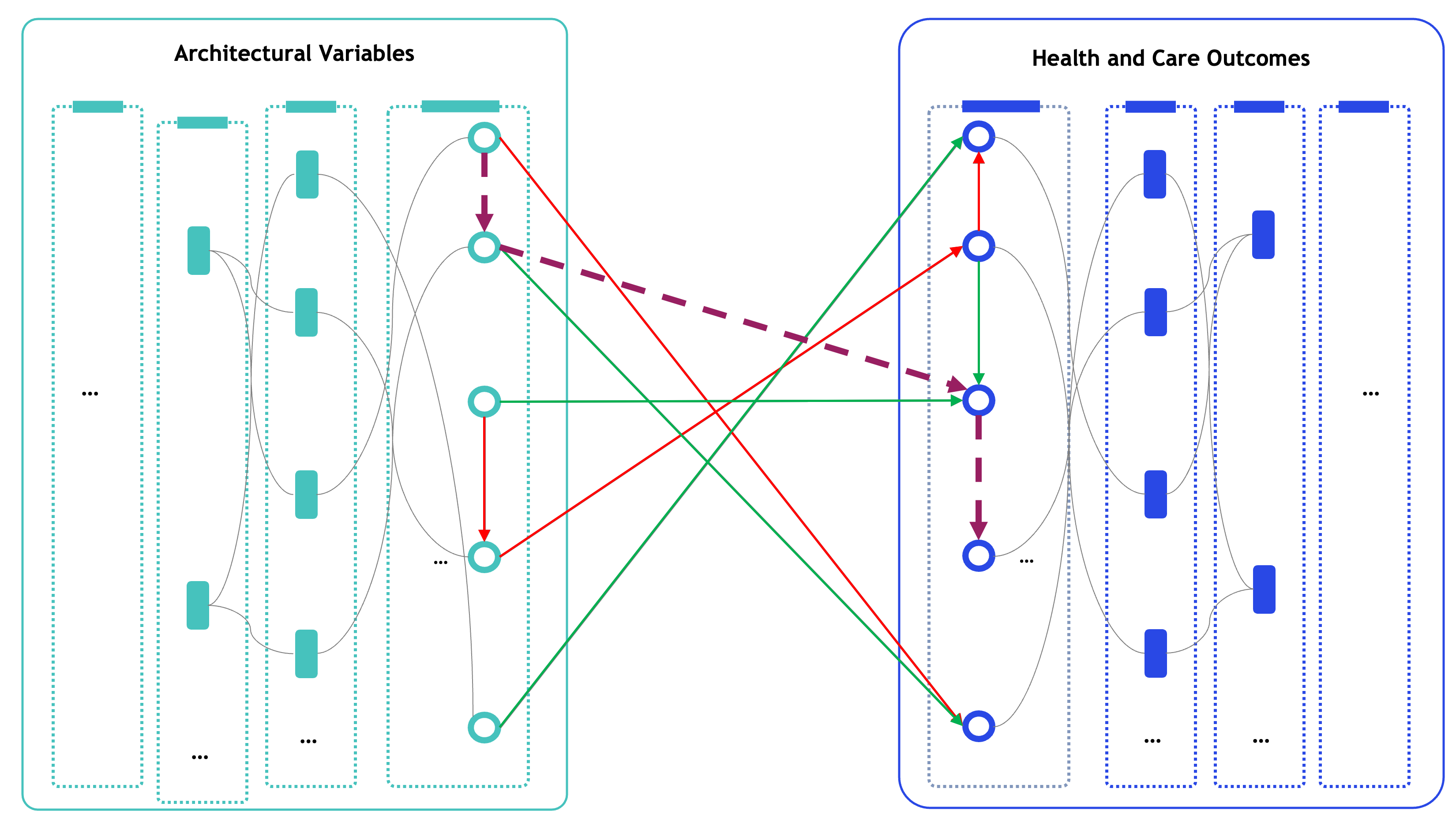
The integrated root-cause and gap analysis systematically represents deviations between the current state of a facility and defined scientific or normative target values. Measured or assessed spatial parameters are compared with referenced benchmarks derived from health, care, and planning standards. The result is a structured representation of performance deficits, strengths, and critical deviations across different levels of spatial and functional organization.
On this basis, the underlying causes contributing to specific deviations are identified, such as unfavorable material selection, spatial configuration, or usage patterns. The analysis thus forms a traceable decision-making foundation for deriving targeted architectural measures that improve both user well-being and the functional and operational efficiency of the facility.
Quantitative and Qualitative Evaluations
The system transforms the architecture of a healthcare facility into a hybrid evaluation model that combines numerical precision with content-related depth. Fact & Feeling assigns a quantitative value to each architectural variable, expressing its specific contribution to promoting or impairing health. Instead of relying on vague descriptions, the software calculates exactly to what extent individual parameters—such as light intensity in therapy areas or the spatial complexity of corridor systems—achieve defined health goals. This mathematical weighting allows for precise scaling, making the performance of different areas within the healthcare facility immediately comparable and objectively evaluable.
Complementing the numerical analysis, the software provides deep qualitative insights to fully unlock the structural background of the results. Fact & Feeling performs a detailed root-cause analysis that explains why specific variables influence the users' well-being. It examines how, for example, room geometry or lighting design affect the psyche and physiology in detail. While quantification determines the "how much," the qualitative component clarifies the "why." This dual approach makes it possible not only to identify architectural problems on the surface but to understand them at the root.
The merging of both evaluation methods forms the basis for targeted optimization that considers both mathematical facts and logical causalities. Fact & Feeling makes the effectiveness of the architecture transparent for operators and investors by highlighting critical areas for action while providing the logical justification for necessary interventions. This ensures that every structural change in the healthcare facility is based on a valid database that ensures functional efficiency and human well-being alike.
Categorized and Prioritized Recommendations
An essential part of the analysis is the automatic categorization of results, which organizes the need for action according to thematic focus areas. Fact & Feeling goes beyond the mere representation of deficiencies and provides a clear prioritization of necessary measures. The system evaluates which architectural adjustments in the healthcare facility have the greatest positive influence on safety, well-being, and operational processes.
This structured prioritization assists operators and planners in deploying resources specifically where they achieve the highest therapeutic impact. The software ensures that architectural recommendations are not presented as a disorganized list, but as a strategic roadmap. This ensures an efficient and quality-oriented optimization of the healthcare facility based on valid data and a clear logical ranking of intervention areas.
Comparison with Best-Practice Models
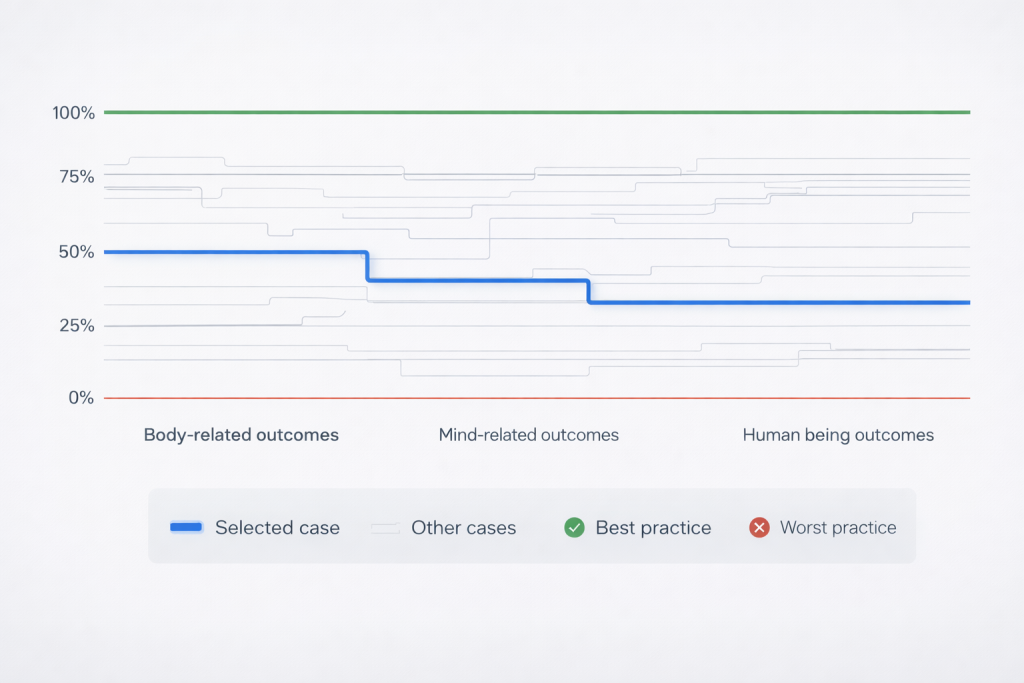
The analysis includes an automated comparison with established best-practice models in the healthcare sector. Fact & Feeling thus positions the healthcare facility precisely within the current competitive environment. The system uncovers relative strengths as well as weaknesses compared to leading standards and provides objective benchmarks for quality-oriented optimization.
Through this detailed classification of structural performance, a solid basis is created to secure the competitiveness of the healthcare facility in the long term and to raise the quality of care to an excellent level. This process allows operators not only to rectify existing deficits but to actively orient themselves toward international top standards and implement innovative spatial concepts. The resulting validation of the architecture also serves as a strong signal to investors and payers, as it scientifically substantiates the future viability of the property through measurable reference values.
Automated and High-Precision Evaluation
By using advanced mathematical algorithms, the evaluation of architectural data is fully automated and highly precise. This digital process eliminates human sources of error, ensures a consistent analysis of hundreds of variables, and significantly accelerates the assessment of the healthcare facility. The result is valid, objective data that forms a sound and reliable basis for strategic design decisions and optimization processes.
Continuous Scientific Updating
The software's algorithms are continuously updated with the latest findings from evidence-based research and healthcare architecture. This keeps the logic of interactions between space and health constantly up to date. Fact & Feeling thus guarantees recommendations that meet the most modern scientific standards and ensures that the healthcare facility benefits from the latest advances in medical architecture.