
Services and Workflow
The services of Fact & Feeling are designed as a continuous, modular service model that links assessment, architectural planning, and construction implementation within a coherent structure. Each phase can be commissioned independently and is at the same time coherently embedded within the overall process.
Through the systemic integration of assessment, planning, and implementation, a closed service cycle is created that translates architectural decisions into the built environment in a data-driven, transparent, and quality-assured manner. The services support operators, planners, and investors in the structured development, operational implementation, and long-term safeguarding of spatial and health-related quality.

Systematic Assessment and Analytical Condition Audit
This phase forms the methodological and substantive foundation for all subsequent planning and implementation decisions. The assessment is based on a classified, multi-layered structure of architectural variables and their linkage to defined health and care outcomes. Both direct and indirect impact pathways are considered, including linear and non-linear relationships as well as cascading effects between spatial factors and health-related criteria.
The assessment logic combines quantitative indicators with qualitative root-cause analyses and integrates benchmarks derived from scientific reference values and best-practice models. In this way, a formal and transparent reference framework is established for evaluating the spatial and functional quality of a facility.
Scope of Services
- Collection of planning documents, as-built documentation, and operational information
- Conducting structured on-site inspections and area-specific analyses
- Professional exchange with operators, planners, and other relevant stakeholders
- Classification of architectural variables by space type, usage, materiality, lighting, acoustics, air quality, and operational parameters
- Linking variables to health and care criteria across the domains of physical health, psychology, and performance
- Calculation of direct and indirect impact pathways, including linear and non-linear interactions
- Execution of root-cause, gap, and risk analyses
- Quantitative and qualitative evaluation of spatial performance profiles
- Benchmarking against scientific reference values and best-practice models
Results
- Structured assessment report with area-specific performance profiles
- Identification of strengths, deficiencies, and critical deviations
- Visualized prioritization of action areas based on impact and urgency
- Documented cause-and-effect relationships as a decision-making basis
- Reference-based positioning of the facility in a qualitative comparison
Architectural Planning for Optimization
In this phase, the results of the systematic assessment are translated into concrete architectural planning strategies. The focus lies on the targeted improvement of identified deficiencies and the strengthening of performance-relevant spatial qualities. The planning follows a consistent methodology in which design-related, functional, and technical measures are directly derived from the prioritized assessment results.
Architectural planning takes into account spatial organization, operational processes, regulatory requirements, and user-specific needs. This ensures that the developed concepts are not only design-oriented, but also functionally and operationally effective.
Scope of Services
- Development of spatial and functional planning concepts based on prioritized action areas
- Preparation of design drawings, functional diagrams, and space utilization concepts
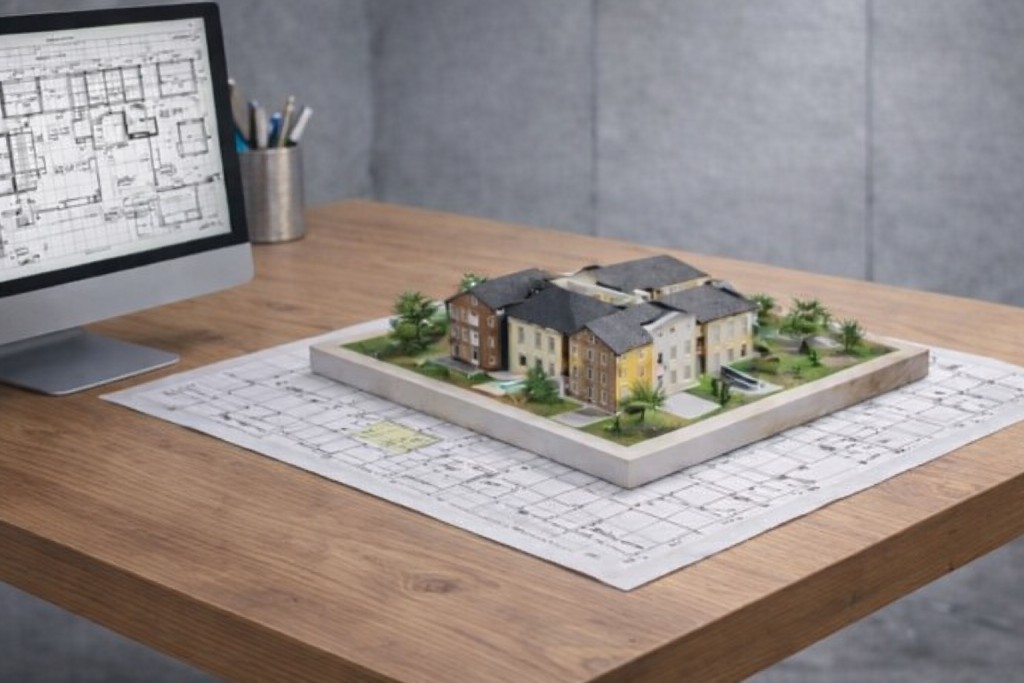
- Development of 3D models and visualizations to illustrate planned measures
- Formulation of technical and construction-related proposals
- Alignment of planning with operational workflows, usage requirements, and regulatory frameworks
- Coordination with specialist planners and external project stakeholders
- Iterative refinement of planning based on feedback and assessment results
Results
- Consistent architectural planning concept with a clear action framework
- Design documentation and visualizations to support decision-making
- Technically and functionally aligned action plans
- Documented traceability between assessment results and planning decisions

Professional Construction Support and Quality Assurance
This phase establishes the link between planning and actual construction execution. The objective is to ensure that the quality and health criteria defined during assessment and planning are consistently implemented in the built outcome. Construction support follows a structured control and feedback framework in which deviations are systematically recorded and reintegrated into the assessment structure.
Quality assurance serves both the technical verification of execution and the substantive safeguarding of health- and use-related objectives of the measure.
Scope of Services
- Professional support during relevant phases of construction execution
- Verification of alignment between execution planning and built realization
- Documentation of deviations and construction-specific conditions
- Coordination with executing companies and project stakeholders
- Feedback of implementation data into the assessment and quality framework
- Support during acceptance procedures and quality inspections
Results
- Documented quality assurance reports
- Verified alignment between assessment, planning, and implementation
- Updated performance profiles of the realized measures
- Reliable foundation for future optimizations and continuous development
