
Product features and characteristics for optimizing environmental factors
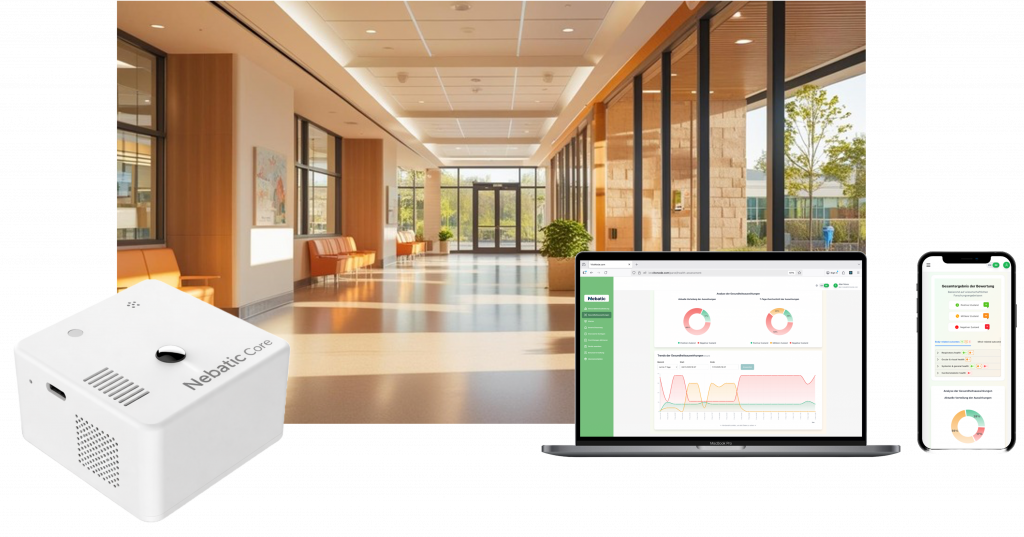
The integrated hardware-software system is designed and developed to contribute to the creation of healthy indoor environments while also reducing the workload of caregiving and technical staff by operating reliably and independently in the background without requiring additional technical effort. Well-thought-out automatic and smart functions enable stable operation with high everyday usability and minimal need for supervision.
All-in-one hardware and software solution – specially designed for healthcare settings
The integrated system combines sensor hardware with a custom-built software platform. The system operates as a fully integrated solution, without the need for additional devices or software installations. For you, this means: easy handling, reduced technical effort, and minimal maintenance – ideal for facilities with limited resources or no in-house IT staff.
Wireless real-time data transmission for improved environmental monitoring
All measurement data – such as temperature, air quality, humidity, or noise – is transmitted wirelessly and in real time. This allows you to place sensors flexibly in any room of the facility – without the need for wiring or structural modifications. This flexibility is especially beneficial in sensitive areas such as resident rooms, therapy spaces, or common areas. Continuous real-time monitoring helps care staff respond more quickly to changes – before the indoor environment negatively impacts well-being.
Easy deployment – flexibly expandable as needed
No structural modifications required – The device simply needs to be powered and immediately begins collecting data.
Effortless scalability – Whether you want to monitor a single room or an entire building, the integrated system grows with your needs.
Multiple nodes (devices) per floor or unit – All data is consolidated on a single platform and can be accessed remotely – ideal for management staff and external quality assessments.
Continuous automatic analysis of environmental factors with a focus on health and well-being
Environmental factors are not only recorded but are continuously analyzed algorithmically with a focus on their potential health impact. Insights into physical and mental health, as well as performance capacity, are systematically incorporated into the evaluation. This creates a solid foundation for targeted optimization of environmental conditions and the sustainable promotion of well-being.
Threshold values & automatic alerts
Define individual threshold values for environmental factors. If a value is exceeded – for example, high CO₂ levels or excessive noise – you receive an automatic notification. This allows care staff or facility management to intervene early, before discomfort arises or health risks escalate.
Intuitive, self-explanatory software
The user interface is designed to be suitable for both technical and non-technical users. Care staff, management, or external specialists can easily view, compare, and use the environmental data as a basis for decision-making – without the need for training. All functions are visually structured and intuitive – making them easy to understand even for larger teams or rotating users.
Custom access rights for team members and partners
Define who can view or manage which data. For example, you can grant a ward manager access to their own units, while central administration or external auditors receive only selected reports – fully GDPR-compliant and secure.
Integration with smart devices and automated control in your facility
The system can be connected to various smart devices in the facility, such as air purifiers, heating, ventilation, or lighting systems. If a previously defined threshold is exceeded – for example, due to poor air quality, increased temperature, or excessive noise – an appropriate response is triggered automatically. This ensures not only continuous monitoring of environmental conditions but also targeted, automated control – without manual intervention by staff. It creates stable, health-promoting indoor conditions while reducing the daily workload for care staff and facility management.
All-in-one solution of hardware and software – designed for the healthcare sector
The product combines sensor hardware with an integrated software platform – a solution that simplifies daily routines, especially in healthcare facilities and care environments. The system works immediately without additional installations. For teams in care homes, clinics, or assisted living facilities, this means: less effort, easier usage, and reliable data directly from daily operations. Especially in environments where technology should be as unobtrusive and stable as possible in the background, the product offers real relief. The concrete benefits for you:
-
Minimal Effort
Ready to use immediately in care settings – no prior knowledge, no additional devices, no external support needed.
-
Direct Functionality
Simply plug in and start – for example in residents’ rooms, lounges, or care stations.
-
System Stability
Even with long-term use in care environments, the system remains reliable and low-maintenance.
Wireless real-time data transmission for better room monitoring
The product transmits all captured environmental data – such as temperature, humidity, air quality, and noise – wirelessly and in real time. This makes placement in different areas of a healthcare facility especially flexible: whether in residents’ rooms, therapy rooms, or common areas – the devices work without structural modifications and do not interfere with care operations. Continuous data transmission enables staff to respond early to changes – before room conditions negatively impact residents or staff. Your benefits at a glance:
-
Fast Reaction
In care or lounge areas, irregularities can be identified immediately, and actions taken right away – without delay.
-
Maximum Flexibility
The wireless sensors can be used effortlessly in large or frequently changing spaces – e.g., also in shared rooms or mobile therapy units.
-
Live Data Instead of Snapshots
Instead of spot measurements, teams receive continuous information – useful for care visits, daily planning, or documentation of room conditions.
Easy to use – flexibly expandable as needed
The product is ready for immediate use – no structural changes or complex setup required. It simply needs a power source and starts data transmission right away. This is especially beneficial in care facilities: rooms can be equipped step by step, depending on demand or budget. Later expansions – from individual rooms to entire wards or buildings – are easy and straightforward. All data is centrally collected and available for authorized staff, such as care managers or external quality auditors.
What the product offers in everyday use:
-
Plug-and-Play
Ideal for care rooms, lounges, or quiet zones: simply plug in and go – without interrupting ongoing operations.
-
Scalability
Whether one room or multiple wards – the system grows with your needs. New devices can be added at any time.
-
Universal Use
Suitable for healthcare facilities of various sizes and types – from small care homes to large rehabilitation clinics.
Continuous automatic analysis of environmental factors with a focus on health and well-being
The product does not just measure environmental factors – it continuously analyzes them with regard to their impact, e.g., on the physical and mental condition of residents or staff. Especially in care environments with sensitive individuals, targeted evaluation of temperature, air quality, and noise provides valuable insights. The system detects patterns of recurring stress and supports the adaptation of spatial and care conditions – promoting well-being in daily life.
-
Individual Recommendations
For example, ventilation suggestions or noise reduction actions in resident rooms, common areas, or therapy rooms.
-
Pattern Recognition
Repeated anomalies – e.g., nightly noise on a specific ward – are detected and documented for targeted improvements.
-
Evidence-based Decisions
Insights gained can be used for care planning, spatial adjustments, or improving organizational processes in healthcare facilities.
Thresholds & automatic notifications
With this product, healthcare facilities can define custom thresholds for room climate, air quality, or noise—tailored to specific rooms or user groups. If a value exceeds the limit, the system sends an automatic alert—e.g., to care staff, facility management, or ward supervisors. This allows action to be taken before complaints arise or risks develop. Especially in the daily routines of care environments, where many responsibilities converge, this feature offers a high level of safety and relief. Why it’s useful for your facility:
-
No Need for Constant Monitoring
Caregivers are automatically informed when action is required—e.g., in the case of critical CO₂ levels in a resident’s room.
-
Individually Configurable Limits
Thresholds can be defined according to room use and user group (e.g., dementia wards, therapy rooms).
-
Increased Safety and Prevention
Critical developments are detected early—protecting both residents and staff while supporting a proactive care culture.
Intuitive, self-explanatory software
The product’s user interface is designed to be easily operated even by non-technical users—ideal for diverse personnel in care facilities and healthcare institutions. Whether care staff, ward managers, or external specialists—all can quickly access and interpret relevant environmental data. The visual design and simple navigation allow for fast responses without training effort. Even with changing staff or rotating teams, the interface remains user-friendly. Particularly helpful in care settings:
-
Admin vs. Observer Functions
In care facilities, for example, team leads can make advanced settings, while staff access current values only.
-
Data Security through Role-Based Access
Every role—whether hygiene officer or external auditor—sees only relevant information, in a structured and privacy-compliant way.
-
Clear Permissions – No Confusion
Especially useful for large teams or multi-ward environments: clearly defined access rights prevent unintentional changes and ensure order.
Individual access rights for team members and partners
The product enables fine-grained permission management—a major advantage for facilities with multiple teams, departments, and external stakeholders. For example, management can access data for their specific areas, while central administration can view aggregated data across all departments. External hygiene officers, medical staff, or inspectors can be granted targeted and time-limited access—secure, GDPR-compliant, and technically precise. This function is especially valuable in large healthcare institutions with complex structures, ensuring clarity and control. Here’s how your team benefits:
-
Seamless Integration without Additional Devices
Roles and permissions are directly managed in the system—ideal for care facilities that want to avoid external tools.
-
Automated Reactions to Environmental Data
Specific user roles can trigger automatic reactions—e.g., facility management receives alerts when temperature limits are exceeded in therapy rooms.
Connection to smart devices and automatic control in the facility
The product doesn’t just measure—it can also act. Upon request, it can connect with your smart devices such as air purifiers, ventilation systems, heaters, or lighting systems and trigger actions automatically—without staff intervention. This offers tangible relief in healthcare settings where maintaining stable indoor conditions for residents is critical. For example, poor air quality in a lounge could automatically trigger a window opener or air purifier. It delivers consistent, health-promoting room conditions and significantly reduces workload for care teams. Key benefits include:
-
Automatic Reaction to Deviations
e.g., in resident rooms: when CO₂ levels rise, the ventilation system starts automatically—without manual action.
-
Reduced Workload for Care Staff
The system handles routine tasks—ideal for the busy everyday life in care facilities.
-
Optimal Indoor Climate for Sensitive Groups
Stable conditions support the well-being of elderly, ill, or cognitively impaired individuals.
-
Integration into Existing Technology
Existing smart devices (e.g., lighting or ventilation) can be easily connected—even retroactively.
-
More Time for Care
Fewer manual interventions mean more time for direct care and attention.
