General information, not legal advice (status: October 2026). This article explains the German rules; other EU countries implement the directive in their own laws. The binding text is the German Energy Efficiency Act (Energieeffizienzgesetz, EnEfG) and Directive (EU) 2023/1791.
The recast EU Energy Efficiency Directive requires every member state to make large energy users run an energy management system and others to carry out regular energy audits. Germany went further, earlier: the German Energy Efficiency Act already applies to companies above 2.5 and 7.5 gigawatt hours (GWh) a year, well below the EU thresholds. Because hospitals run around the clock, many hospitals and clinics in Germany sit in that range. This article starts with the EU framework in Article 11 of the directive, then uses Germany as a worked case: who counts as a company, which duties apply, what the 2026 amendment bill would change, and how continuous meter and room data support an energy management system. It is written for hospital directors, estates and energy managers, healthcare operator groups and the consultants who advise them.
Key points
- EU framework: Article 11 of Directive (EU) 2023/1791 requires a certified energy management system for companies averaging more than 85 terajoules (TJ) a year by 11 October 2027, and an energy audit at least every four years for companies above 10 TJ without one [2].
- Germany is stricter today: the EnEfG requires implementation plans and waste heat measures above 2.5 GWh (9 TJ) and an energy or environmental management system above 7.5 GWh (27 TJ) [8][9][10][11].
- Hospitals are energy-intensive: in Germany, the average hospital alone used about 6.8 GWh of natural gas in 2021 [19]. What counts, however, is the consumption of the whole company, not one building.
- Amendment pending: a 2026 government bill would raise the German thresholds to 23.6 GWh and 2.77 GWh, close to the EU values. As of mid-October 2026 it has not been adopted [16][17][18].
EED Article 11: the EU starting point
Directive (EU) 2023/1791 on energy efficiency was adopted on 13 September 2023 and entered into force on 10 October 2023 [1]. Member states had until 11 October 2025 to transpose most of it into national law [3]. The European Commission describes it as making “energy efficiency first” a fundamental principle of EU energy policy and extending the audit obligation to all companies above a consumption threshold, regardless of size [5].
Article 11 sets the core company duties [2]:
- Energy management system. Companies whose average annual energy consumption over the previous three years exceeds 85 TJ must implement an energy management system, certified by an independent body against European or international standards, by 11 October 2027.
- Energy audit. Companies above 10 TJ that do not have an energy management system must undergo an energy audit, the first by 11 October 2026, and then at least every four years, carried out by qualified or accredited experts.
- Action plan. On the basis of the audit recommendations, companies must draw up a concrete and feasible action plan, presented to management, covering each recommendation that is technically or economically feasible.
- Publication. The action plan and the rate of implementation of recommendations must be published in the company’s annual report, subject to the protection of trade and business secrets.
For orientation: 85 TJ is about 23.6 GWh and 10 TJ about 2.8 GWh (own conversion, 1 GWh = 3.6 TJ). As the worked example below shows, a mid-sized acute hospital can reach the lower threshold; large hospitals and operator groups may reach the upper one.
The public sector: Article 5
Article 5 adds a separate duty for the public sector: member states must ensure that the total final energy consumption of all public bodies combined falls by at least 1.9 per cent a year compared with 2021 [4]. Until 11 October 2027 the target is indicative [4]. Hospitals are not named specifically, so whether a publicly owned hospital is a “public body” depends on national law, as the German case below shows.
The German Energy Efficiency Act: why it matters for hospitals
Germany set its company duties before the directive’s transposition deadline; the deadlines in § 8 of the act refer to November 2023 [8]. The duties depend on energy consumption, not on sector or company size. For hospitals that matters, because their consumption is high. The research service of the German Bundestag cites roughly 6,000 to 10,000 kWh of electricity and 25,000 to 29,000 kWh of heat per bed per year for German hospitals [20]. The German Hospital Institute (Deutsches Krankenhausinstitut, DKI) found average natural gas consumption of about 6.81 million kWh per hospital in 2021, with a range from under 1 GWh to over 21 GWh [19].
Worked example: is a hospital above the threshold?
Worked example (illustrative, based on averages): a 350-bed hospital with consumption within the per-bed ranges above [20] would use 350 × (6,000 + 25,000) kWh to 350 × (10,000 + 29,000) kWh a year, about 10.9 to 13.7 GWh. It would be above both German thresholds, but below the EU’s 85 TJ (23.6 GWh). A smaller 80-bed clinic would use about 2.5 to 3.1 GWh, right at the 2.5 GWh line.
Assumptions: the per-bed values are rough averages for acute hospitals; rehabilitation, psychiatric and care settings have different profiles; vehicle fuels are not included. The real check uses the company’s bills for the last three completed calendar years.
Who counts as a company under the EnEfG
The EnEfG ties its duties to companies and their total final energy consumption (Gesamtendenergieverbrauch), defined as the total final energy consumed over a given period [6]. The leaflet of the Federal Office for Economic Affairs and Export Control (BAFA) explains how to apply this [13]:
- Company. The obligated company is the smallest legally independent unit with its own accounts and balance sheet, including its branches and sites. The definition is functional: any entity carrying out an economic activity counts, regardless of legal form and without a profit motive [13].
- Consumption. All commercial forms of energy count, including fuels, heat, renewable energy, electricity, motor fuels and aviation fuel [13].
- Period and cut-off date. The average of the last three completed calendar years, determined on 1 January each year [13].
- Evidence. Values must be verifiable, mainly through bills; documented and justified estimates are allowed where data is missing [13].
Two points matter for hospitals. First, non-profit operators are companies in this sense; charitable status does not exempt them. Second, consumption is added up across all sites of the same legal entity, so an operator with several hospitals or care homes in one company may cross a threshold even if each site is small. For groups with several legal entities, the boundary is a question for legal advice.
Public bodies: a separate regime
Public bodies (öffentliche Stellen) are excluded from the company definition [13] and fall under § 6 instead. The act defines them as authorities, judicial bodies and other public-law institutions, corporations, institutions and foundations under public law of the federal government or the states and their associations. Private-law persons and companies with a commercial or industrial character and municipalities are not included; legal persons under public or private law that are mainly financed by institutional grants from the federal government or the states are included [6]. Public bodies with annual final energy consumption of 1 GWh or more must save 2 per cent a year; those at 3 GWh or more had to set up an energy or environmental management system by 30 June 2026, and those between 1 and 3 GWh a simplified one [7]. Hospitals are not named in this definition, so whether a particular hospital is a public body or a company depends on its legal form, owner and financing. That is a legal question to be settled with legal advice or BAFA’s guidance; this article does not make that classification.
EnEfG duties at a glance
| Consumption (3-year average) | Duty | Legal basis | Deadline | Maximum fine |
|---|---|---|---|---|
| above 2.5 GWh | Draw up, confirm and publish implementation plans for economic savings measures | § 9 EnEfG | 3 years after audit or (re)certification | €50,000 |
| above 2.5 GWh | Avoid, reduce and reuse waste heat where possible and reasonable | § 16 EnEfG | ongoing | €100,000 |
| above 2.5 GWh | Report waste heat data to the Federal Agency for Energy Efficiency; answer requests | § 17 EnEfG | annually by 31 March | €50,000 |
| above 7.5 GWh | Energy management system (ISO 50001) or environmental management system (EMAS) with minimum content | § 8 EnEfG | 18 July 2025 (threshold reached by 17 Nov 2023) or 20 months after reaching it | €100,000 |
| companies under § 1 No. 4 EDL-G | Energy audit every four years; exempt with EnMS or EMAS | § 8 EDL-G | 4 years from last audit | – |
Table 1: Duties under the EnEfG in force and the Energy Services Act (EDL-G). Sources: [8][9][10][11][12][15]. Status: October 2026.
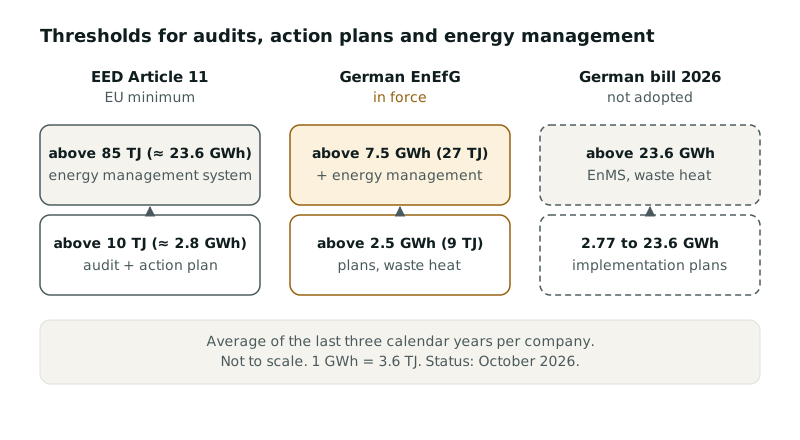 Figure 1: Thresholds in the EU directive, the German act in force and the German bill that has not been adopted. Simplified. Sources: [2][8][9][16].
EnEfG energy management system: the 7.5 GWh duty
Companies above 7.5 GWh must set up an energy or environmental management system [8]. In the act, an energy management system means one that meets ISO 50001 [6]; an environmental management system under EMAS is accepted as an alternative [13]. Companies that had reached the threshold by 17 November 2023 had to set up the system by the end of 18 July 2025; those reaching it later have 20 months [8]. Until the system is in place, and at most until these deadlines, they are exempt from the audit duty under the Energy Services Act [8]. As proof, BAFA requires a valid ISO 50001 certificate from an accredited certification body or a valid EMAS registration [13].
The German act also goes beyond the standard. Under § 8(3), the system must at least include [8]:
- recording of energy inputs and outputs, process temperatures, waste heat media with their temperatures and heat quantities, and technically avoidable and unavoidable waste heat, including a check of whether waste heat can be recovered and used;
- identification of technically feasible final energy savings and waste heat measures;
- an economic assessment of those measures under DIN EN 17463 (December 2021).
ISO 50001 in hospitals or EMAS?
ISO 50001:2018 provides a framework for establishing, running and improving an energy management system on the Plan-Do-Check-Act model; it is technology-neutral and applies to organisations of any type or size [21]. EMAS is an environmental management scheme in which energy is one aspect among several. Hospitals already building a wider sustainability or environmental management system may prefer EMAS; those focusing on energy usually choose ISO 50001. A guide from the State Energy Agency of Saxony-Anhalt (LENA) describes, for hospitals, elements such as anchoring energy targets in hospital management, a responsible energy manager and an annual audit to evaluate results and set new targets [22].
Implementation plans and waste heat
Implementation plans above 2.5 GWh
German companies above 2.5 GWh must draw up concrete, feasible implementation plans for all measures identified as economic in their management system or energy audit, have them confirmed and publish them within three years [9]. A measure is economic if, assessed under DIN EN 17463, it reaches a positive net present value within at most half its service life; only measures with a service life of up to 15 years are considered [9]. A certifier, environmental verifier or energy auditor must confirm completeness and correctness before publication [9], and BAFA’s leaflet adds that this must not be someone who set up or ran the system [13]. Trade secrets need not be published [9].
The act requires a plan, not the investment. Whether and when a hospital invests remains its decision. That makes the plan a tool: it shows which measures pay off, and it needs reliable data so that assumed savings can be checked later.
Waste heat
Companies above 2.5 GWh must, where possible and reasonable, avoid waste heat according to the state of the art and reduce it to the technically unavoidable share, and reuse the waste heat that still arises where possible and reasonable [10]. They must also report the location, annual heat quantity, maximum thermal output, availability as load profiles, controllability and average temperature of their waste heat to the Federal Agency for Energy Efficiency (BfEE) by 31 March each year; the agency publishes it on a public platform while protecting trade secrets [11]. The BfEE explains that sources below the bagatelle thresholds in its leaflet do not need to be reported and that reporting does not create a duty to use the heat; the platform covers over 3,000 companies with more than 24,000 waste heat potentials and about 209 TWh a year [14]. In hospitals, possible sources include chillers or laundries; whether a source must be reported depends on the thresholds in the leaflet.
EnEfG amendment 2026: where the bill stands
On 25 June 2026 the German government presented a bill to accelerate the transposition of the Energy Efficiency Directive (Bundesrat document 388/26) [16]. Among other things, it would [16][17]:
- raise the threshold for an energy or environmental management system from 7.5 GWh to 23.6 GWh,
- require implementation plans for companies between 2.77 and 23.6 GWh, within three months of completing an energy audit,
- remove the waste heat reporting duty for most companies, keeping it for companies above 23.6 GWh and data centres above 1 MW,
- replace § 16 with a cost-benefit analysis of waste heat use when large installations are planned or substantially modernised.
The Bundestag debated the bill (document 21/8027) at first reading on 24 September 2026 and referred it to the Committee on Economic Affairs and Energy, which held a public hearing on 5 October 2026 [17][18]. As of mid-October 2026, no second or third reading and no adoption are recorded [17][18]. Until a new law is promulgated, the current EnEfG applies with its thresholds and deadlines.
The bill would bring Germany close to the EU values in Article 11: 23.6 GWh corresponds to 85 TJ and 2.77 GWh to about 10 TJ. For hospitals between 7.5 and 23.6 GWh this creates an awkward situation: today they need a management system, after an amendment perhaps not. A system already in place stays useful, and for many the set-up deadline has already passed. Those without one should clarify their position with legal advice rather than wait.
Energy Efficiency Directive energy audit obligation in Germany
Separately from the EnEfG, the German Energy Services Act (Energiedienstleistungsgesetz, EDL-G) requires companies within the meaning of its § 1 No. 4 to carry out an energy audit every four years; companies with an energy management system or EMAS, or that have started to set one up, are exempt [15]. Whether a hospital operator falls under § 1 No. 4 depends on its size and should be checked with an adviser.
Setting up an energy management system for hospitals
An energy management system is organisation first and technology second. A practical sequence:
- Assign responsibility. Board, energy manager, head of estates.
- Establish the baseline. Consumption by energy carrier for recent years, main consumers, existing meters.
- Write a metering plan. Which sub-meters and data sources are needed to cover significant energy uses and areas?
- Set indicators and targets. Energy per bed, per floor area or per department; targets for the coming years.
- Assess measures. Economic assessment under DIN EN 17463, as § 8 and § 9 require in Germany [8][9].
- Check the effect. Before-and-after comparisons with the same data, then adjust targets.
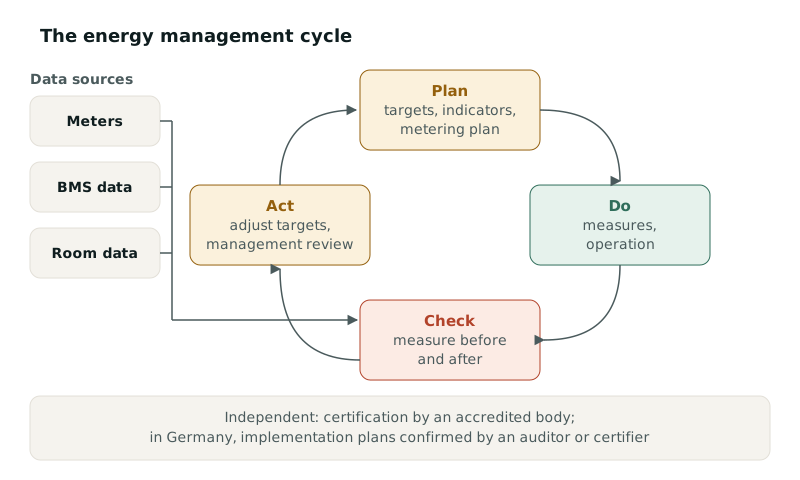 Figure 2: The energy management cycle and its data sources. Own illustration. Sources: [8][13][21].
What data a hospital energy management system needs
| Data source | What it shows | Use in the energy management system |
|---|---|---|
| Main meters per energy carrier | Total consumption, billing | Threshold check, energy balance [13] |
| Sub-meters (buildings, departments, large consumers) | Consumption by area and time | Indicators, significant energy uses |
| Building management system | Run times, set points, plant status | Causes of excess use, measures |
| Heat meters, temperatures | Heat flows, waste heat | Minimum content under § 8(3) in Germany [8] |
| Room data (temperature, humidity, CO₂) | Conditions in rooms | Checking whether measures change room conditions |
Table 2: Building blocks of a metering plan. Own compilation based on [8][13].
The last row matters in hospitals. A measure that saves energy but makes patient rooms too warm or therapy rooms stuffy risks being reversed. Room data shows whether room conditions stay within the agreed ranges.
Common mistakes
- Wrong boundary. Looking at one hospital when the company has several sites, or forgetting motor fuels [13].
- Waiting for the amendment. The current act applies until a change is promulgated.
- A system on paper. A certificate without a metering plan gives no reliable indicators and no verifiable measures.
- Plans without checks. Implementation plans are published, but nobody checks whether the measures deliver.
- Forgetting the rooms. Energy measures are carried out without checking how conditions in patient rooms and treatment areas change.
- Bypassing infection prevention. Changes to ventilation in critical areas without the hygiene team.
How Fact & Feeling helps
Fact & Feeling measures room conditions (CO₂, particulate matter, VOC, temperature, humidity, light and sound) and brings existing data together. The AI platform shows rooms on the floor plan with live values, trends, issues and hints. For an energy management system for hospitals, that means:
- Consumption by area. Through data integration, energy meters, BMS data and existing sensors come together on one platform, room by room and site by site. That helps an operator group build one EnEfG energy management system data basis across sites.
- Continuous data. Monitoring supplies ongoing trends from meters and rooms that fill a metering plan with data.
- Evidence for measures. Audit and analysis shows where energy is used without benefit and provides readings before and after a measure, which supports action plans under EED Article 11 or German implementation plans. It does not replace the DIN EN 17463 assessment or confirmation by auditors and certifiers.
- Rooms in view. Alongside consumption, the platform shows whether patient rooms, therapy rooms and day rooms stay within agreed ranges.
For rehabilitation clinics, the platform reflects the weekly rhythm of therapy times and arrival days. How the devices and software support ISO 50001 in hospitals is described under platform and devices.
What Fact & Feeling is not: it is not an energy management system under ISO 50001 or EMAS, not a certification body, not an energy audit under EN 16247-1 or the EDL-G, and not legal or energy consultancy. Fact & Feeling does not certify anything and does not promise legal compliance or savings. It provides data and analyses that your energy manager, consultants and auditors can use.
Limits and risks
- Legal advice. Whether your company crosses a threshold, whether it is a public body and which deadlines apply should be checked with legal advice or BAFA’s guidance. This article reflects the position in October 2026.
- Energy consultants and auditors. Energy audits, the DIN EN 17463 assessment and the confirmation of implementation plans belong with qualified auditors, certifiers and environmental verifiers.
- Certification. An ISO 50001 certificate is issued by an accredited certification body [13].
- Infection prevention. Energy measures on ventilation in theatres, critical care or isolation rooms belong with the infection prevention team and must comply with the applicable standards.
- Funding. Whether a measure can be funded is a question for the relevant authority. This article does not promise any funding.
- Amendment. If the bill is adopted, thresholds, deadlines and content may change. Check the current text.
- Other countries. Outside Germany, the national transposition of Article 11 applies. Thresholds, deadlines and penalties differ.
Frequently asked questions
What is the German Energy Efficiency Act?
The Energieeffizienzgesetz (EnEfG) is Germany’s energy efficiency law, with duties for companies and public bodies [7]. For companies it requires implementation plans and waste heat measures above 2.5 GWh and an energy or environmental management system above 7.5 GWh a year [8][9][10].
What does EED Article 11 require?
An independently certified energy management system for companies above 85 TJ a year by 11 October 2027, and for companies above 10 TJ without one, an energy audit by 11 October 2026 and then at least every four years, with an action plan and publication in the annual report [2].
Does the German Energy Efficiency Act apply to hospitals?
Yes. It applies to companies according to their consumption, including non-profit operators [13]. Public-law hospitals of the federal government or the states may instead fall under the rules for public bodies [6][7].
Is ISO 50001 mandatory for hospitals in Germany?
Not as such. Above 7.5 GWh, a hospital company needs an energy management system meeting ISO 50001 or an environmental management system under EMAS [8][13]. Below that, it is voluntary under the EnEfG.
What does the 2026 EnEfG amendment change?
The bill would raise the management system threshold to 23.6 GWh, apply implementation plans between 2.77 and 23.6 GWh and drop waste heat reporting for most companies [16]. It has not been adopted as of mid-October 2026 [17][18].
Do care homes fall under the EnEfG?
Yes, with the same thresholds. What counts is the consumption of the operating company across all its sites, not a single home [13].
What is the difference between an energy audit and an energy management system?
An audit is a periodic, structured review of energy use with recommendations. A management system is a continuous process of targets, measures, checks and improvement, typically certified under ISO 50001 [21]. In both the EU and German rules, a management system exempts a company from the audit duty [2][15].
Do I need software for an energy management system?
The standard does not require specific software [21]. In practice, a hospital with many meters, buildings or sites benefits from a platform that brings data together and makes indicators comparable.
Sources
- European Union (2023): Directive (EU) 2023/1791 of the European Parliament and of the Council of 13 September 2023 on energy efficiency and amending Regulation (EU) 2023/955 (recast). https://eur-lex.europa.eu/eli/dir/2023/1791/oj
- Directive (EU) 2023/1791, Article 11 Energy management systems and energy audits (German text at gesetze.legal). https://gesetze.legal/eu/rl_2023_1791_eu/11
- Directive (EU) 2023/1791, Article 36 Transposition (German text at gesetze.legal). https://gesetze.legal/eu/rl_2023_1791_eu/36
- Directive (EU) 2023/1791, Article 5 Public sector leading in energy efficiency (German text at gesetze.legal). https://gesetze.legal/eu/rl_2023_1791_eu/5
- European Commission: Energy Efficiency Directive. https://energy.ec.europa.eu/topics/energy-efficiency/energy-efficiency-targets-directive-and-rules/energy-efficiency-directive_en
- Federal Ministry of Justice (Germany): Energieeffizienzgesetz (EnEfG), § 3 Definitions (No. 16 energy management system, No. 19 total final energy consumption, No. 22 public bodies). https://www.gesetze-im-internet.de/enefg/__3.html
- Federal Ministry of Justice (Germany): Energieeffizienzgesetz (EnEfG), § 6 Energy saving obligation of public bodies. https://www.gesetze-im-internet.de/enefg/__6.html
- Federal Ministry of Justice (Germany): Energieeffizienzgesetz (EnEfG), § 8 Energy or environmental management systems. https://www.gesetze-im-internet.de/enefg/__8.html
- Federal Ministry of Justice (Germany): Energieeffizienzgesetz (EnEfG), § 9 Implementation plans. https://www.gesetze-im-internet.de/enefg/__9.html
- Federal Ministry of Justice (Germany): Energieeffizienzgesetz (EnEfG), § 16 Avoidance and use of waste heat. https://www.gesetze-im-internet.de/enefg/__16.html
- Federal Ministry of Justice (Germany): Energieeffizienzgesetz (EnEfG), § 17 Waste heat platform. https://www.gesetze-im-internet.de/enefg/__17.html
- Federal Ministry of Justice (Germany): Energieeffizienzgesetz (EnEfG), § 19 Fines. https://www.gesetze-im-internet.de/enefg/__19.html
- Federal Office for Economic Affairs and Export Control (BAFA) (2024): Merkblatt für das Energieeffizienzgesetz (EnEfG), version 1.2, 1 March 2024 (copy hosted by IHK Arnsberg). https://ihk-arnsberg.de/upload/ea_merkblatt_energieefffizienzgesetz_47381.pdf
- Federal Agency for Energy Efficiency (BfEE) at BAFA: Plattform für Abwärme (waste heat platform). https://www.bfee-online.de/BfEE/DE/Effizienzpolitik/Plattform_fuer_Abwaerme/plattform_fuer_abwaerme_node.html
- Federal Ministry of Justice (Germany): Energiedienstleistungsgesetz (EDL-G), § 8 Energy audits. https://www.gesetze-im-internet.de/edl-g/__8.html
- Bundesrat (2026): Government bill on accelerating the transposition of the Energy Efficiency Directive, document 388/26 of 25 June 2026. https://dserver.bundestag.de/brd/2026/0388-26.pdf
- German Bundestag (2026): First reading on the transposition of the Energy Efficiency Directive (document 21/8027), 24 September 2026. https://www.bundestag.de/dokumente/textarchiv/2026/kw39-de-energieeffizienzrichtlinie-1211306
- German Bundestag (2026): Public hearing of the Committee on Economic Affairs and Energy on the Energy Efficiency Directive, 5 October 2026. https://www.bundestag.de/dokumente/textarchiv/2026/kw41-pa-wirtschaft-energieeffizienzrichtlinie-1218082
- Deutsches Krankenhausinstitut (2022): Erdgasverbrauch und -kosten der Krankenhäuser, analysis for the German Hospital Federation. https://www.dki.de/fileadmin/user_upload/20220926_Erdgasverbrauch_und_-kosten_Krankenhaus_DKI_Analyse_final.pdf
- Research Services of the German Bundestag (2023): Verteilung der Energiekostenunterstützung für Krankenhäuser, WD 5 - 3000 - 059/23. https://www.bundestag.de/resource/blob/958254/WD-5-059-23-pdf.pdf
- ISO (2018): ISO 50001:2018 Energy management systems – Requirements with guidance for use. https://www.iso.org/standard/69426.html
- Landesenergieagentur Sachsen-Anhalt (LENA): Energieeffizienz für Krankenhäuser in Sachsen-Anhalt. https://lena.sachsen-anhalt.de/fileadmin/Bibliothek/Sonstige_Webprojekte/Lena/Dokumente/FB_Wirtschaft/Leitfaden_Krankenhaus/LENA_Energieeffizienz-f-Krankenhaeuser-in-S-T_web.pdf