General information, not legal advice (status: October 2026). The legal texts are authoritative: Directive (EU) 2024/1275 and, for Germany, section 56 GModG. This article explains the EU rule and, as a worked case, the German rules; other EU countries implement the directive in their own laws.
The EPBD building automation 70 kW rule is one of the less visible but more concrete obligations in the recast Energy Performance of Buildings Directive (EPBD). By the end of 2029, non-residential buildings whose heating or air-conditioning systems exceed 70 kW must have building automation and control systems (BACS), where technically and economically feasible [1]. For hospitals and clinics, almost all of which are large non-residential buildings with substantial heating and ventilation plant, this is a deadline with practical consequences. This article explains what Article 13 of the EPBD requires, which healthcare buildings are affected, what the required functions – including indoor environmental quality monitoring – mean in a hospital, and how Germany has turned the rule into national law in section 56 of its Building Modernisation Act.
Key points
- EU rule: Article 13 of Directive (EU) 2024/1275 requires BACS in non-residential buildings with systems above 290 kW by 31 December 2024 and above 70 kW by 31 December 2029, where technically and economically feasible [1].
- Required capabilities: continuously monitoring, logging, analysing and allowing for adjusting energy use; benchmarking efficiency, detecting efficiency losses and informing the responsible person; interoperability across proprietary technologies; and, from 29 May 2026, monitoring indoor environmental quality [1].
- Lighting: automatic lighting controls, suitably zoned and capable of occupancy detection, are required in the same buildings above 70 kW by the end of 2029 [1].
- Germany as a case: section 56 of the Building Modernisation Act (Gebäudemodernisierungsgesetz, GModG), in force since 29 July 2026, applies the 70 kW threshold and the end-2029 deadline to non-residential buildings, including the monitoring of indoor climate quality [2][4][5]. Care homes count as residential buildings under German law and are not covered [3].
- What to do now: map which buildings and systems exceed 70 kW, assess the existing building management system (BMS) against the required functions, and plan how indoor environmental quality will be measured – with design engineers, infection prevention and legal advice.
EPBD building automation 70 kW rule: what Article 13 requires
The EPBD recast was adopted on 24 April 2024, and member states had to transpose most of it by 29 May 2026 [1]. Article 13 deals with technical building systems. Its building automation provisions have three parts that matter for hospitals [1]:
Thresholds and deadlines. Non-residential buildings with an effective rated output for heating, air-conditioning, combined heating and ventilation, or combined air-conditioning and ventilation of more than 290 kW had to be equipped with BACS by 31 December 2024. Those above 70 kW must follow by 31 December 2029. Both obligations apply where technically and economically feasible [1].
Capabilities. The systems must be capable of [1]:
- continuously monitoring, logging, analysing and allowing for adjusting energy use;
- benchmarking the building’s energy efficiency, detecting losses in efficiency of technical building systems, and informing the person responsible for the facilities or technical building management about opportunities for improvement;
- allowing communication with connected technical building systems and other appliances inside the building, and being interoperable with technical building systems across different types of proprietary technologies, devices and manufacturers;
- from 29 May 2026, monitoring indoor environmental quality.
Lighting. Non-residential buildings above 290 kW need automatic lighting controls by 31 December 2027, and those above 70 kW by 31 December 2029, where technically and economically feasible; the controls must be suitably zoned and capable of occupancy detection [1].
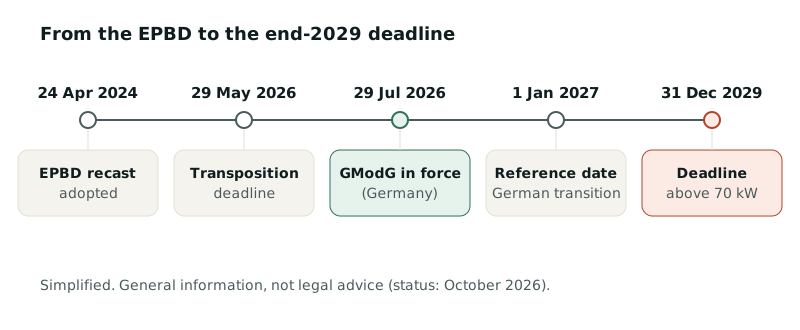 Figure 1: From the EPBD recast to the end-2029 deadline, with the German implementation as an example. Sources: [1][2][4].
The directive defines a building automation and control system as a system comprising products, software and engineering services that can support the energy-efficient, economical and safe operation of technical building systems through automatic controls and by facilitating their manual management [1]. A BMS is often the core of such a system, but having a BMS does not by itself mean that every listed capability is in place.
Which healthcare buildings are covered?
The EPBD obligation targets non-residential buildings. Acute hospitals, specialist clinics, rehabilitation clinics and psychiatric hospitals are clearly non-residential: they exist to treat people, not primarily to house them.
Care homes are less clear-cut, and here national law decides: the EPBD does not name care homes in this rule, so how a care home is classified for the 70 kW rule follows each country’s transposition. In Germany, the Building Modernisation Act expressly includes residential homes, old people’s homes and care homes (Wohn-, Alten- und Pflegeheime) in its definition of residential buildings [3], so the German automation duty does not apply to them. Hospices, medical practices in mixed-use buildings and day clinics need case-by-case assessment.
The 70 kW threshold refers to the rated output of heating and air-conditioning systems (including combined systems with ventilation), not to annual consumption [1]. For most hospitals and clinics it is likely to be exceeded, as the worked example below illustrates, but the deciding figure is the installed rated output, which your estates team or design engineers can confirm.
Worked example (illustrative)
Worked example (illustrative), assumptions: an 80-bed rehabilitation clinic. Using a German reference value of about 29,000 kWh of heat per hospital bed per year [12], annual heat demand would be about 2,320 MWh. Assuming 1,800 full-load hours, that corresponds roughly to a heating output of about 1,300 kW. Even if a rehabilitation clinic needs considerably less heat per bed than an acute hospital, the output in this example would be far above 70 kW. The example does not replace a check of the actual rated output of your systems.
BACS requirements for hospitals in practice
What do the four capabilities mean in a hospital? The table translates them into operational terms.
| EPBD capability [1] | What it means in a hospital | Data needed |
|---|---|---|
| Monitor, log, analyse and adjust energy use | Continuous tracking by building, area and plant, not annual meter reading | Meters and sub-meters, BMS data |
| Benchmark, detect efficiency losses, inform the responsible person | Reference values; spotting plant that behaves unusually, such as ventilation running at full speed in empty periods; reporting to estates | Plant data, schedules, occupancy, consumption history |
| Communication and interoperability | Data accessible regardless of supplier; systems that can talk to each other | Open interfaces and exports |
| Monitor indoor environmental quality | Conditions in the rooms themselves, not only at the plant | Room data such as temperature, humidity, CO₂ |
Table 1: The EPBD BACS capabilities and their meaning in a hospital (simplified; the directive text is authoritative). Sources: [1].
BACS indoor air quality monitoring requirement
The fourth capability is new and particularly relevant for healthcare. The EPBD requires BACS to be capable of monitoring indoor environmental quality from 29 May 2026 [1]. That shifts attention from plant rooms to occupied rooms. Which parameters and which rooms make sense should be agreed with design engineers. EN 16798-1 provides a recognised framework for indoor environmental parameters covering indoor air quality, thermal environment, lighting and acoustics [9].
Hospitals add a further layer. Specialised ventilation in theatres, critical care and isolation rooms follows its own guidance – in Germany DIN 1946-4, in England HTM 03-01 – and the requirements of the infection prevention team [10][11]. Monitoring indoor environmental quality for the EPBD does not replace hygiene assessments or any monitoring that infection prevention or medical engineering require for particular areas. Conversely, anyone automating in specialised ventilation areas needs the infection prevention team involved from the start.
Germany as a case: GModG section 56
This section explains the German rules; other EU countries implement the directive in their own laws.
Germany transposed the building automation rule through a reform of its Buildings Energy Act (Gebäudeenergiegesetz, GEG). The amending act of 23 July 2026 was published in the Federal Law Gazette (BGBl. 2026 I No. 226) on 28 July 2026 [4]. Since 29 July 2026 the act has been called the Building Modernisation Act (Gebäudemodernisierungsgesetz, GModG), and the automation duty sits in section 56 [2][5]. According to an overview by the law firm Gleiss Lutz, it now applies to non-residential buildings from 70 kW instead of the previous 290 kW, considerably widening the scope of the former rule in section 71a GEG [5].
GModG building automation requirements in brief [2]:
- Scope and deadline: non-residential buildings with a heating system, combined space heating and ventilation system, air-conditioning system or combined air-conditioning and ventilation system with a rated output of more than 70 kW must be equipped with a building automation and control system by the end of 31 December 2029 (bis zum Ablauf des 31. Dezember 2029), unless this is technically not possible or economically unreasonable (wirtschaftlich unzumutbar).
- Functions (para. 2): continuous monitoring, logging, analysis and adjustment of energy use; access to the data through a common, freely configurable interface so that analysis is possible independently of company and manufacturer; efficiency reference values for the building; detection of efficiency losses; informing the operator about possible improvements; and monitoring of indoor climate quality (Raumklimaqualität).
- New buildings (para. 3): minimum automation level B under DIN/TS 18599-11:2025-10 for systems above 290 kW and level C above 70 kW, technical commissioning management including adjustment over at least one heating and, where relevant, one cooling season, and interoperability across manufacturers.
- Transition (para. 4): a transition rule with a longer deadline for existing buildings in which a non-compliant system was installed in the three years before 1 January 2027.
- Lighting (para. 6): automatic lighting control by the end of 2029, unless technically not possible or economically unreasonable; it should be suitably zoned and have occupancy detection.
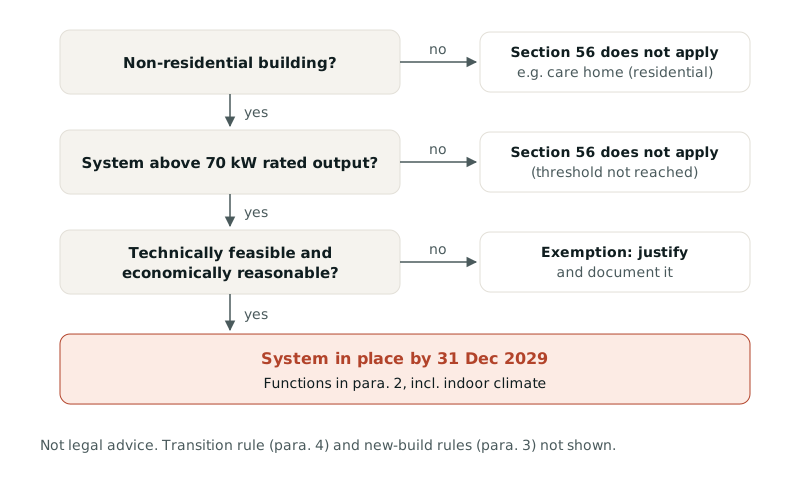 Figure 2: Simplified check of whether section 56 GModG applies to a building in Germany. Not legal advice; details and exemptions in the legal text. Sources: [2][3].
German hospital operators should also keep the Energy Efficiency Act (Energieeffizienzgesetz, EnEfG) in view. It requires companies with an average annual total final energy consumption of more than 7.5 GWh over the last three completed calendar years to implement an energy or environmental management system [6]. A bill amending the EnEfG to implement the recast Energy Efficiency Directive (EU) 2023/1791 [8] (government bill to accelerate the implementation of the Energy Efficiency Directive, Bundestag printed paper 21/8027) had its first reading on 24 September 2026 and a committee hearing on 5 October 2026; it had not been adopted by mid-October 2026 [7]. The energy management duty concerns organisation; the automation duty concerns the building’s technical equipment. They are related but separate.
Building automation deadline 2029: a roadmap
Planning, tendering, installation and commissioning take time in a hospital that cannot close. A staged roadmap helps.
| Step | Content | Who is involved |
|---|---|---|
| 1. Classify | Which buildings are non-residential? Which systems exceed 70 kW rated output? | Estates, legal |
| 2. Take stock | Existing BMS, meters, sensors, interfaces, age of systems | Estates, design engineers |
| 3. Assess gaps | Which required capabilities are missing? Where is room data missing? | Design engineers |
| 4. Concept | Metering plan, data routes, open interfaces, scope of indoor environmental quality monitoring, hygiene requirements | Design engineers, infection prevention, IT |
| 5. Check exemptions | Document technical feasibility and economic reasonableness per building | Design engineers, legal |
| 6. Implement | Tender, installation, commissioning, training | Estates, contractors |
| 7. Operate | Continuous analysis, reports to the responsible people, improvements | Estates, energy management |
Table 2: A possible roadmap to 31 December 2029 (simplified, not legal advice). Sources: [1][2].
No general figure can be given for the cost of a hospital BMS upgrade. It depends on how much BMS is already in place, how many systems need connecting, how accessible plant rooms are and how many rooms are equipped for indoor environmental quality monitoring. Whether funding programmes apply changes over time; check with the relevant authorities and your energy adviser.
Common mistakes in a hospital BMS upgrade
Waiting until 2029. Every non-residential building above 70 kW in the EU faces the same deadline. Specialist contractors will be busy.
“We already have a BMS.” An existing BMS is a good starting point, but it does not automatically provide continuous analysis, detection of efficiency losses, open interfaces or indoor environmental quality monitoring. Check each capability.
Closed systems. Buying new components without open interfaces risks failing the interoperability requirement of the directive and, in Germany, the requirement for a common, freely configurable interface [1][2].
Forgetting the rooms. Many concepts focus on plant and meters. Indoor environmental quality monitoring needs readings from rooms.
Undocumented exemptions. Anyone relying on technical infeasibility or economic unreasonableness should be able to justify it with figures and expert assessment.
Involving infection prevention too late. Automating specialised ventilation areas [10][11] without the infection prevention team leads to delays at best.
How Fact & Feeling helps
Fact & Feeling is a room data platform for healthcare buildings. Sensors measure CO₂, particulate matter, volatile organic compounds (VOCs), temperature, humidity, light and sound in selected rooms and send the readings over Wi-Fi to the platform, which shows every room on the floor plan with live values, trends, issues and hints. In relation to the EPBD rule, it can help in several places:
- Indoor air quality monitoring per room: the platform provides the room-level data that concepts for indoor environmental quality monitoring need, with devices only where measuring points are missing.
- Bringing BMS, meters and sensors together: existing BMS data, meters and sensors are combined and mapped to rooms; open interfaces make the data available to your own systems.
- From audit to automation: our services for a hospital BMS upgrade: a measuring phase shows which data exists, where room data is missing and which plant behaves unusually – input for your design engineers. Where systems are connected, the platform can control them within limits your facility sets, or give recommendations; sensitive areas stay with recommendations.
What Fact & Feeling does not do: it does not confirm that a building complies with the EPBD or section 56 GModG, and it does not replace design engineers, energy advice or legal review. Whether an overall system meets the obligation is for design engineers and, where needed, lawyers to judge for your building. For specific settings, see our pages on GModG building automation in hospitals, rehabilitation clinics facing the building automation deadline 2029 and care homes, which in Germany fall outside the duty.
Limits and risks
- Law: this article is general information, not legal advice (status: October 2026). Whether the rule applies to a particular building, whether an exemption applies and how transition rules work should be checked with your legal team or a lawyer, under the law of your country.
- Design and energy advice: specifying, tendering and accepting a BACS belongs with design engineers. Energy advisers help assess economics and measures.
- Infection prevention: specialised ventilation areas follow their standards and the infection prevention team [10][11]. Automatic control there only in agreement with them.
- Medical equipment and safety: building automation does not replace safety-related systems, monitoring of medical devices or manufacturer maintenance.
- Changing rules: national transpositions are new, and further amendments, regulations or guidance are possible. Check the current legal position.
- Funding: whether funding applies is for the relevant authorities to decide. This article makes no statement about it.
Frequently asked questions
What is the EPBD 70 kW building automation rule?
Under Article 13 of Directive (EU) 2024/1275, non-residential buildings with heating, air-conditioning or combined ventilation systems with an effective rated output above 70 kW must be equipped with building automation and control systems by 31 December 2029, where technically and economically feasible [1].
Does the EPBD building automation rule apply to hospitals?
Hospitals are non-residential buildings, so the rule applies where their systems exceed 70 kW (or 290 kW for the earlier deadline) and installation is technically and economically feasible [1]. The details depend on national transposition.
What are the BACS requirements for hospitals?
The system must be capable of continuously monitoring, logging, analysing and adjusting energy use; benchmarking and detecting efficiency losses and informing the responsible person; communicating and being interoperable across manufacturers; and monitoring indoor environmental quality [1].
What does the indoor environmental quality monitoring requirement mean?
From 29 May 2026, BACS must be capable of monitoring indoor environmental quality [1]. In practice that means readings from rooms, such as temperature, humidity and CO₂. EN 16798-1 offers a framework for the parameters [9].
What is GModG section 56?
It is the German implementation: section 56 of the Building Modernisation Act requires non-residential buildings with systems above 70 kW to be equipped with building automation and control by 31 December 2029, including monitoring of indoor climate quality, unless technically not possible or economically unreasonable [2].
Do care homes have to install building automation in Germany?
Not under section 56 GModG. German law counts care homes as residential buildings [3], and section 56 applies to non-residential buildings.
What happened to section 71a GEG?
Section 71a of the former Buildings Energy Act contained the earlier German duty for non-residential buildings above 290 kW. Since the reform, the duty sits in section 56 GModG and applies from 70 kW [5].
Is our existing BMS enough?
Only a building-specific assessment can tell. An existing BMS often covers part of the requirements. Check each capability, particularly interoperability, open interfaces and indoor environmental quality monitoring.
Sources
- European Union (2024): Directive (EU) 2024/1275 of 24 April 2024 on the energy performance of buildings (recast), Articles 2, 13 and 35. https://eur-lex.europa.eu/eli/dir/2024/1275/oj/eng
- Gebäudemodernisierungsgesetz (GModG), § 56: Gebäudeautomatisierung und Gebäudesteuerung (Building Modernisation Act, section 56). https://www.gesetze-im-internet.de/geg/__56.html
- Gebäudemodernisierungsgesetz (GModG), § 3: Begriffsbestimmungen (definitions, para. 1 nos. 23 and 33). https://www.gesetze-im-internet.de/geg/__3.html
- Bundesgesetzblatt (2026): BGBl. 2026 I Nr. 226 of 28 July 2026, Act of 23 July 2026 amending the Buildings Energy Act. https://www.recht.bund.de/bgbl/1/2026/226/VO.html
- Gleiss Lutz (2026): Überblick über das neue Gebäudemodernisierungsgesetz (overview of the new Building Modernisation Act). https://www.gleisslutz.com/de/know-how/ueberblick-ueber-das-neue-gebaeudemodernisierungsgesetz
- Energieeffizienzgesetz (EnEfG), § 8: Einrichtung von Energie- oder Umweltmanagementsystemen (Energy Efficiency Act, section 8). https://www.gesetze-im-internet.de/enefg/__8.html
- Deutscher Bundestag (2026): Public hearing of the Committee on Economic Affairs and Energy on the bill to accelerate the implementation of the Energy Efficiency Directive (Entwurf eines Gesetzes zur Beschleunigung der Umsetzung der Energieeffizienzrichtlinie, printed paper 21/8027), 5 October 2026. https://www.bundestag.de/dokumente/textarchiv/2026/kw41-pa-wirtschaft-energieeffizienzrichtlinie-1218082
- European Union (2023): Directive (EU) 2023/1791 on energy efficiency (recast). https://eur-lex.europa.eu/eli/dir/2023/1791/oj/eng
- DIN EN 16798-1:2022-03 (EN 16798-1:2019): Energy performance of buildings – Ventilation for buildings – Part 1: Indoor environmental input parameters for design and assessment of energy performance of buildings addressing indoor air quality, thermal environment, lighting and acoustics. DIN Media. https://www.dinmedia.de/de/norm/din-en-16798-1/349622591
- DIN 1946-4:2018-09: Ventilation and air conditioning – Part 4: Ventilation in buildings and rooms of health care. DIN Media. https://www.dinmedia.de/de/norm/din-1946-4/294438653
- NHS England (2021): Health Technical Memorandum 03-01: Specialised ventilation for healthcare premises. https://www.england.nhs.uk/publication/specialised-ventilation-for-healthcare-buildings/
- Landesenergieagentur Sachsen-Anhalt (LENA) (n.d.): Energieeffizienz für Krankenhäuser in Sachsen-Anhalt (energy efficiency for hospitals). https://lena.sachsen-anhalt.de/fileadmin/Bibliothek/Sonstige_Webprojekte/Lena/Dokumente/FB_Wirtschaft/Leitfaden_Krankenhaus/LENA_Energieeffizienz-f-Krankenhaeuser-in-S-T_web.pdf