General information, not legal advice (status: October 2026).
If you advise hospitals, clinics or care homes on energy, ventilation hygiene or facilities management, your work usually ends with a report. The report recommends a change to a heating schedule, a ventilation setback or a new set point. What happens afterwards in the building, you rarely see. An indoor air quality monitoring service changes that: continuous room data on temperature, humidity, CO₂ and other conditions, set against meter data, shows whether a measure saved energy and whether the rooms stayed where they should be. This article is for energy consultants, infection prevention and control (IPC) advisers and FM providers who want to offer their healthcare clients continuous room data rather than a one-off snapshot, without building a monitoring platform of their own.
Key points
- Healthcare estates are large energy users. The NHS estate in England alone used 11.3 billion kWh in 2024/25 [1]. EU rules require energy audits, energy management and building automation with indoor environmental quality monitoring; in the UK, ESOS requires energy assessments from large undertakings [2][3][4].
- A recommendation is only proven when a baseline is measured first and the result is checked afterwards with the same method. ISO 50015 and the IPMVP describe how [7][8].
- In healthcare, the result includes the room: temperature, humidity and CO₂ as a ventilation indicator show whether a measure changed conditions for patients, residents and staff. Specialised ventilation in theatres, critical care and isolation rooms follows its own standards [6][14].
- Continuous monitoring turns a one-off engagement into ongoing advice, with the platform, sensors and data handling supplied by a specialist.
Why healthcare clients ask for more than a report
Hospitals run around the clock, every day of the year, and their rooms differ widely: wards, diagnostics, theatres, kitchens, laundries, offices. NHS England Digital’s Estates Returns Information Collection reports total energy consumption across the NHS estate of 11.3 billion kWh for 2024/25, a total estate running cost of £14.0 billion and an estimated £15.9 billion needed to eradicate backlog maintenance [1]. In Germany, a guide by the Saxony-Anhalt state energy agency gives average annual figures per hospital bed of about 6,000 kWh of electricity and 29,000 kWh of heat, and puts energy at 3 to 5 per cent of a hospital’s total costs [9].
Clients also face targets and duties that make advice necessary rather than optional:
- NHS net zero. The NHS in England has committed to reach net zero for the emissions it controls directly by 2040, with an ambition of an 80 per cent reduction by 2028 to 2032 [5].
- Energy audits and energy management in the EU. The recast Energy Efficiency Directive (EED) requires enterprises using on average more than 85 TJ a year over the previous three years to have a certified energy management system by 11 October 2027, and those above 10 TJ without one to complete an energy audit by 11 October 2026 and then at least every four years [3].
- ESOS in the UK. The Energy Savings Opportunity Scheme applies to large undertakings (250 or more employees, or turnover above £44 million and a balance sheet above £38 million) and requires an assessment every four years. Public sector organisations usually do not need to comply, but private hospital groups and care home operators may [4].
- Building automation in the EU. The recast Energy Performance of Buildings Directive (EPBD) requires building automation and control systems (BACS) in non-residential buildings with an effective rated output above 290 kW by 31 December 2024 and above 70 kW by 31 December 2029 [2]. These systems must monitor energy use continuously, benchmark efficiency, allow interoperability and, by 29 May 2026, be able to monitor indoor environmental quality [2].
This article explains the EU rules and, where relevant, how Germany applies them; other EU countries implement the directives in their own laws. In Germany, § 56 of the Building Modernisation Act (Gebäudemodernisierungsgesetz, GModG) implements the BACS duty for non-residential buildings above 70 kW by 31 December 2029, including monitoring of indoor climate quality (“Raumklimaqualität”). Care homes count as residential buildings there and are not covered [15][16].
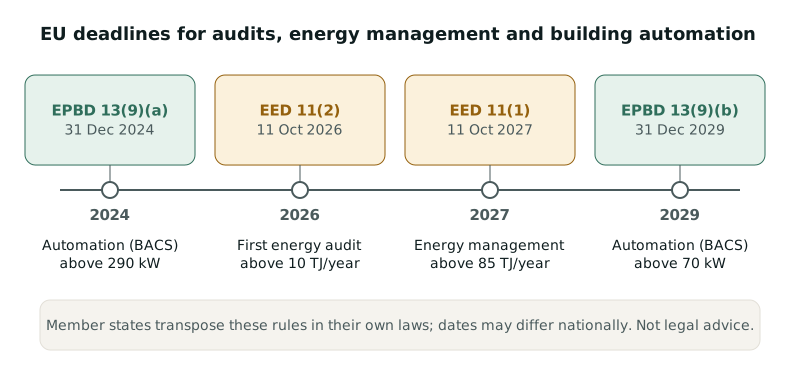 Figure 1: EU deadlines that create demand for healthcare energy consulting. Sources: [2][3].
Worked example (illustrative): Take a 400-bed hospital that matches the German per-bed averages in [9]. It would use about 400 × (6,000 + 29,000) kWh = 14 GWh a year, which is roughly 50 TJ. That is above the EED’s 10 TJ audit threshold and below the 85 TJ energy management threshold. Whether a duty applies depends on the whole enterprise, its measured consumption and national law, not on one building. That is for the client’s auditor and lawyers to confirm.
The gap in healthcare energy consulting
Most healthcare energy consulting is good at finding opportunities and weaker at proving results. Several causes come together.
Few sub-meters in grown estates. Hospital sites have often grown over decades, with large pipe infrastructure. A guidance brochure from the state of Baden-Württemberg notes that many facilities lack a clear picture of where and how much energy they use and points to such historically grown building complexes as one reason [10]. If only the main meter exists, the effect of a change on one ward disappears in the noise.
Short measuring campaigns. Consulting budgets favour a few days of logging. A few days do not show weekends, nights, a heatwave or the depth of the heating season, all of which matter in a building that never closes.
Design values instead of operating values. Design documents show how plant should run. The Saxony-Anhalt guide stresses that concrete measured values are the basis for decisions, and that problems such as fans or pumps drawing more power due to dirt or wear only show up through ongoing analysis [9].
Energy and indoor climate are judged separately. The European standard EN 16798-1 treats the energy performance of buildings and the indoor environmental input parameters together [11]. In practice, the energy consultant sees meters, the IPC team sees inspections and the FM provider sees fault calls. Yet a change to ventilation or heating curves can shift exactly the parameters that matter in a patient room.
Many decision makers. Estates, IPC, nursing and the board all have a say. Whoever proposes a measure has to show it will not make rooms worse. Without data, that is an assurance, not evidence.
Common mistakes when measures go live
- No baseline. The change is made before the starting point is measured, so savings can only be estimated.
- Judging by the annual bill. Weather, occupancy and prices move the bill more than many measures. Without adjustment, the effect of the measure stays unclear [7][8].
- No room data. A lower set point saves energy, but nobody checks whether some rooms run cold at night or hot in the afternoon.
- Treating all areas the same. Specialised ventilation in operating theatres, critical care and isolation rooms is governed by standards such as HTM 03-01 in England and DIN 1946-4 in Germany [6][14]. Changes there need the IPC team and the standard, not just an energy case.
- Data that leaves with the consultant. Loggers are removed and results live in a PDF. A year later, nobody knows whether the setting still holds.
What an indoor air quality monitoring service adds
An indoor air quality monitoring service, in the sense used here, means sensors that stay in representative rooms, a platform that stores and shows the data, and regular reporting. For a consultant, it answers two questions at once: did the measure save energy, and did the rooms stay within agreed ranges?
Measurement and verification for healthcare
Two established frameworks describe how to prove a saving. ISO 50015 gives general principles and guidance for measuring and verifying the energy performance of an organisation or its parts, applies to all forms of energy and can be used alongside other protocols [7]. The International Performance Measurement and Verification Protocol (IPMVP) from the Efficiency Valuation Organization compares a baseline period with a reporting period and adjusts for changed conditions. It distinguishes options that isolate the affected equipment, an option based on whole-facility meters and an option based on calibrated simulation [8].
In healthcare, a third element belongs next to these: the indoor environment during both periods.
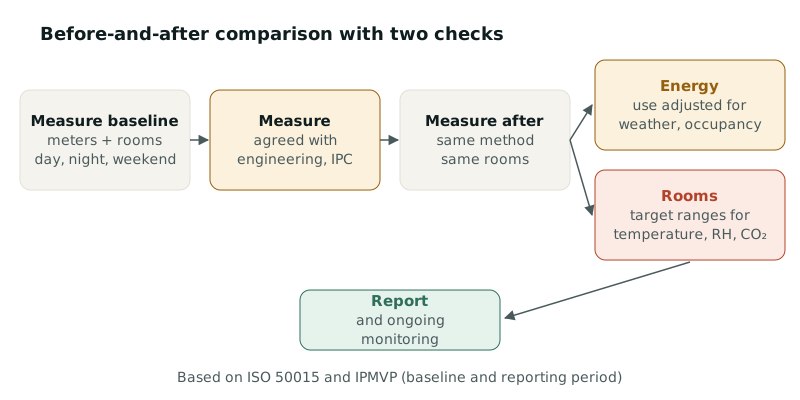 Figure 2: Before-and-after comparison with two checks, energy and rooms. Sources: [7][8].
Table 1: What to measure for a before-and-after comparison in clinical buildings
| Parameter | Why it matters to the consultant | Reference |
|---|---|---|
| Electricity, heat, cooling (main and sub-meters) | Baseline and savings per area | ISO 50015, IPMVP [7][8] |
| Room temperature | Check that new set points stay within the agreed range | EN 16798-1 [11] |
| Relative humidity | Check for changes after ventilation or heating measures | EN 16798-1 [11] |
| CO₂ | Indicator of ventilation under occupancy, for example after airflow or schedule changes | German indoor air guide values [12] |
| BMS operating data | Run times, set points, faults | Technical monitoring guidance [13] |
| Light, sound, particles, VOC | Additional room quality information, relevant for lighting or ventilation measures | depending on the question |
CO₂ is a useful indicator of how much exhaled air is in a room and therefore of ventilation under occupancy. It is not a measure of pathogens. Germany’s committee on indoor air guide values at the Federal Environment Agency classes concentrations below 1,000 ppm as hygienically unobjectionable, 1,000 to 2,000 ppm as hygienically conspicuous and above 2,000 ppm as hygienically unacceptable [12]. Use such values as orientation for general rooms, and agree the target ranges for each room type with the client’s estates and IPC teams.
Indoor air quality consultant healthcare work: where data helps
IPC advisers and ventilation hygiene specialists already inspect, sample and verify. Continuous data adds what happens between visits: how humidity, temperature and CO₂ behave on a Sunday night or during a heatwave. The judgement remains with the IPC team and its advisers. Room data does not replace microbiological sampling, ventilation verification under HTM 03-01 or hygiene inspections [6].
Facilities management providers
For FM providers, the German guideline VDI 6041 describes technical monitoring of buildings and building services and its interfaces to building operation [13]. Monitoring rooms as well as plant can show deviations before they reach the estates helpdesk as a complaint from the ward, so call-outs can be planned rather than reactive.
Building the service: practical choices
Which rooms? Choose rooms that show the differences: a south-facing and a north-facing patient room, a multi-bed bay, a day room, a corridor. Not every room needs a sensor, but the spread should be visible.
How long before the change? The baseline should cover weekdays, weekends and nights. For heating or cooling measures, measure in the relevant season.
Who agrees the targets? Target ranges per room type are agreed in advance with estates, nursing and IPC. In specialised ventilation areas, the IPC team and the applicable standard set the limits, not the consultant [6].
What data quality? Remote-read meters are preferable; the Saxony-Anhalt guide considers battery-powered meters generally unsuitable for ongoing monitoring [9]. Agree measurement intervals and data retention at the start.
Who owns the client relationship? You do. The platform supplies measurement and analysis; your advice, interpretation and recommendations remain yours.
White label energy monitoring or a visible platform?
Some partners look for white label energy monitoring, where software carries the consultant’s brand. Others prefer to keep the platform visible as a tool the client can open, while the advice and reports carry their own name. Both approaches can work. What matters more for healthcare clients is that roles are clear: who measures, who interprets, who decides, and who answers for hygiene.
Care homes and senior living
Care homes differ. In Germany they count as residential buildings, so the building automation duty in § 56 GModG does not apply to them [16]. In the UK, a care home operator falls under ESOS only if it is a large undertaking [4]. The reason for advice is therefore more often cost pressure than a legal duty. At the same time, the care home is the residents’ home, and many residents spend long hours in their rooms. A before-and-after comparison of room temperatures, especially in the heating season and in summer, is particularly valuable here.
How Fact & Feeling helps
Fact & Feeling is the healthcare brand of NodeByNode Systems Design UG in Berlin. Its sensors measure room conditions (CO₂, particulate matter, VOC, temperature, humidity, light and sound) and connect via Wi-Fi. An AI platform shows rooms on the floor plan with live values, trends, issues and hints. For partners who want to offer an indoor air quality monitoring service without building their own, four services fit together:
- Monitoring around the clock: devices stay in place, the platform runs 24/7 and regular reports follow. This is the indoor air quality monitoring service itself, and it produces the “after” data continuously.
- Audit and analysis: a measuring phase in selected areas, with analysis and recommendations. It gives you the baseline before a measure goes live.
- Data integration: building management system (BMS) data, energy meters, existing sensors and interfaces are combined with room data, so existing systems keep their role.
- Platform and devices: one platform where you, the client’s estates team and their IPC advisers see the same room data. It is an alternative to sourcing white label energy monitoring and sensors separately.
Where ventilation, heating, lighting or shading are connected, automation can adjust them within limits the facility sets, or give recommendations instead; sensitive areas stay with recommendations. This fits naturally into healthcare energy consulting services that already cover audits and measures, and it applies across hospitals and clinics as well as care homes.
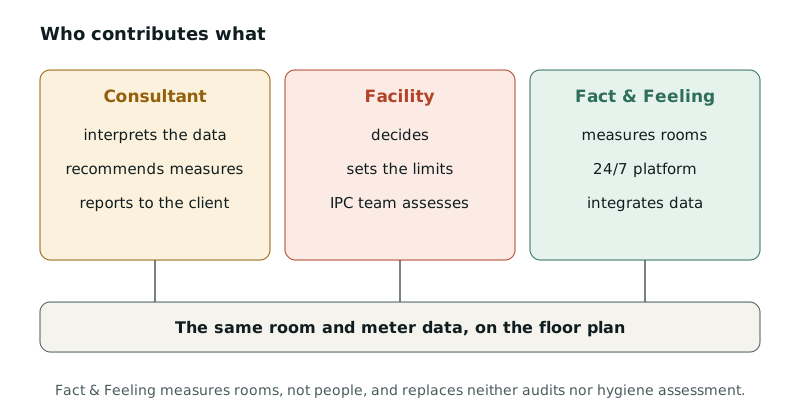 Figure 3: Who contributes what: consultant, facility and Fact & Feeling. Source: Fact & Feeling service descriptions.
If you are looking at an energy management partner programme or simply want to understand how working together could look, you can read about Fact & Feeling and talk to the team through the contact page. How a cooperation works is agreed case by case.
What Fact & Feeling does not do: it measures rooms, not people. It does not diagnose, does not judge hygiene and does not replace energy auditors, IPC specialists, medical engineering, manufacturer maintenance, surveyors or lawyers. It certifies nothing and promises no savings; whether a measure works is shown by measurement.
Limits and risks
- Legal scope: Whether a client falls under the EED, ESOS, national BACS rules or an exemption is for lawyers, auditors and the competent authority to decide. This article is not legal advice.
- Formal audits and certification: Energy audits under EN 16247, ESOS assessments and ISO 50001 certification remain the job of qualified assessors and certification bodies. Monitoring data supports them; it does not replace them.
- Hygiene and specialised ventilation: Changes to airflows, schedules or setbacks in theatres, critical care and isolation rooms only with the IPC team and within HTM 03-01, DIN 1946-4 or the relevant national standard [6][14].
- Health: Room data describes the room, not anyone’s health. Anyone with health complaints should see a doctor.
- Measurement uncertainty: Every measurement has limits. For contractual savings, agree methods and tolerances in advance, for example under the IPMVP [8].
- Building causes: When data shows that the room itself is the cause, for example missing solar shading, planners and architects are needed.
- Funding: Whether advice or monitoring is funded is decided by the funding body under its current rules. Check directly with them.
Frequently asked questions
What is an indoor air quality monitoring service?
A service in which sensors stay in selected rooms, a platform records and displays the data continuously, and reports follow at fixed intervals. In healthcare it typically covers temperature, humidity, CO₂ as a ventilation indicator, particles, VOC, light and sound.
How do healthcare energy consulting firms prove savings?
By measuring a baseline before a measure, a reporting period afterwards, and adjusting for changes such as weather or occupancy. ISO 50015 and the IPMVP describe the principles [7][8]. Room data adds proof that conditions stayed within the agreed range.
Do EU rules require indoor environmental quality monitoring in hospitals?
The recast EPBD requires BACS in non-residential buildings above 290 kW by the end of 2024 and above 70 kW by the end of 2029, and these systems must be able to monitor indoor environmental quality by 29 May 2026 [2]. Each member state implements this in national law, such as § 56 GModG in Germany [15].
Does ESOS apply to NHS trusts?
The UK government says public sector organisations usually do not need to comply with ESOS. Private hospital groups and care home operators may, if they are large undertakings [4]. Check the current guidance for your client.
What is the difference between energy monitoring and an energy audit?
An audit is a project with findings and recommendations at one point in time. Monitoring is continuous recording and analysis. Combined, they make advice whose effect stays visible.
What does an indoor air quality consultant in healthcare do with continuous data?
They see how humidity, temperature and CO₂ develop between visits and can base their advice on it. Sampling, ventilation verification and hygiene judgements remain with the IPC specialists [6].
Is white label energy monitoring necessary to offer the service?
No. Some partners prefer their own branding, others keep the platform visible as a tool. What matters more is that roles and responsibilities are clear to the client.
Sources
- NHS England Digital (2025): Estates Returns Information Collection, Summary page and dataset for ERIC 2024/25. https://digital.nhs.uk/data-and-information/publications/statistical/estates-returns-information-collection/summary-page-and-dataset-for-eric-2024-25
- European Union (2024): Directive (EU) 2024/1275 on the energy performance of buildings (recast), Article 13(9) and (10). https://eur-lex.europa.eu/eli/dir/2024/1275/oj/eng
- European Union (2023): Directive (EU) 2023/1791 on energy efficiency (recast), Article 11. https://eur-lex.europa.eu/eli/dir/2023/1791/oj/eng
- UK Government: Energy Savings Opportunity Scheme (ESOS). https://www.gov.uk/energy-savings-opportunity-scheme-esos
- NHS England: Delivering a net zero NHS. https://www.england.nhs.uk/greenernhs/a-net-zero-nhs/
- NHS England (2021): Health Technical Memorandum 03-01: Specialised ventilation for healthcare premises. https://www.england.nhs.uk/publication/specialised-ventilation-for-healthcare-buildings/
- ISO (2014): ISO 50015 – Energy management systems – Measurement and verification of energy performance of organizations – General principles and guidance. https://www.iso.org/standard/60043.html
- Efficiency Valuation Organization (EVO): International Performance Measurement and Verification Protocol (IPMVP). https://evo-world.org/en/products-services-mainmenu-en/protocols/ipmvp
- Landesenergieagentur Sachsen-Anhalt (LENA) (n.d.): Energieeffizienz für Krankenhäuser in Sachsen-Anhalt. https://lena.sachsen-anhalt.de/fileadmin/Bibliothek/Sonstige_Webprojekte/Lena/Dokumente/FB_Wirtschaft/Leitfaden_Krankenhaus/LENA_Energieeffizienz-f-Krankenhaeuser-in-S-T_web.pdf
- Ministry of the Environment, Climate Protection and the Energy Sector Baden-Württemberg (2017): Energieeffizienz in baden-württembergischen Gesundheitseinrichtungen. https://www.kea-bw.de/fileadmin/user_upload/Publikationen/158_Energieeffizienz_in_bw_Gesundheitseinrichtungen.pdf
- DIN EN 16798-1:2022-03: Energy performance of buildings – Ventilation for buildings – Part 1: Indoor environmental input parameters for design and assessment of energy performance of buildings addressing indoor air quality, thermal environment, lighting and acoustics. https://www.dinmedia.de/de/norm/din-en-16798-1/349622591
- German Environment Agency (UBA), Committee on Indoor Air Guide Values (2008, updated 2022): Hygienische Leitwerte für die Innenraumluft – Kohlendioxid. https://www.umweltbundesamt.de/system/files/medien/4031/bilder/dateien/hygienische_leitwerte_0.pdf
- VDI 6041:2017-07: Facility management – Technical monitoring of buildings and building services. https://www.dinmedia.de/en/technical-rule/vdi-6041/267500673
- DIN 1946-4:2018-09: Ventilation and air conditioning – Part 4: Ventilation in buildings and rooms of health care. https://www.dinmedia.de/de/norm/din-1946-4/294438653
- Gebäudemodernisierungsgesetz (GModG), § 56. https://www.gesetze-im-internet.de/geg/__56.html
- Gebäudemodernisierungsgesetz (GModG), § 3. https://www.gesetze-im-internet.de/geg/__3.html