It is Sunday evening and a ward bay feels stuffy and warm. The nurse in charge rings estates, the on-call engineer arrives, and only then does it emerge that a supply fan has been running at half speed for hours. In many hospitals, ventilation and heating faults are still found this way: by the people who are least able to deal with them. Predictive maintenance for hospital HVAC aims to change that by spotting drifting plant before it reaches the ward. This article explains why faults surface late, how fault detection and diagnostics work, which room and plant data help, and where the limits are. It is written for estates and facilities managers, authorised persons, FM service providers and care home operators. It is not about blaming anyone: plant drifts slowly, and the information arrives too late.
Key points
- The NHS in England estimates the cost to eradicate backlog maintenance at £15.9 billion for 2024/25 [1]. Ageing plant makes early fault detection more valuable, not less.
- HVAC faults are common. In one large study of more than 60,000 pieces of equipment in US commercial buildings, fault detection software reported a fault on 40 per cent of air handling units on any given day [5].
- Many faults begin as slow drift, not hard failure. BMS alarms usually trigger only when a fixed limit is crossed; trends in room and plant data can show the drift earlier.
- A hint system based on room and plant data supports maintenance planning. It does not replace BMS alarms, safety-related alarm systems or contractor maintenance.
Why the ward often finds hospital HVAC faults first
Wards, critical care, emergency departments and on-call theatres are occupied around the clock. Their ventilation, heating and cooling never get a quiet night. When a unit starts to fail, there is no empty room where the problem can go unnoticed.
There are structural reasons why the ward often notices first. A building management system (BMS) watches plant, not rooms. It alarms when a fan stops, a filter passes a set pressure drop or a flow temperature leaves a fixed band. What reaches the individual room is often invisible to it. Nurses feel it immediately: too warm, too cold, stuffy, draughty. They are, in effect, the most sensitive sensors in the building, but they have patients to care for.
NHS backlog maintenance: the context
The condition of the estate adds pressure. NHS England’s Estates Returns Information Collection (ERIC) for 2024/25 puts the estimated cost to eradicate backlog maintenance at £15.9 billion [1]. According to the cost consultancy BCIS, which analysed the ERIC data, that is 15.7 per cent more than the £13.8 billion reported for 2023/24, with significant-risk backlog at £5.6 billion [2]. The Health Foundation found that the backlog more than doubled in real terms between 2015/16 and 2023/24, and that high-risk backlog grew from £1 billion to £2.7 billion over the same period, the fastest-growing risk category [3].
Backlog figures are not fault rates, but they describe plant that is running beyond its planned life. Where replacement has to wait, knowing which units are drifting becomes part of managing risk.
How common HVAC faults are
Published fault rates for hospital HVAC are rare. The best evidence comes from large studies of commercial buildings, which show how widespread faults are in general.
A study led by Lawrence Berkeley National Laboratory analysed fault detection and diagnostics (FDD) output for more than 60,000 pieces of HVAC equipment and over 90 fault types. On any given day, 40 per cent of air handling units and 30 per cent of terminal units had a reported fault of some kind [5]. Twenty-one AHU fault types appeared on at least 20 per cent of AHUs, and 18 persisted for more than 20 per cent of the period covered [5].
That does not mean 40 per cent of units are failing. Many faults are small: a sticking damper actuator, a sensor offset, a valve that does not quite close. They cost energy and comfort long before anyone phones estates. That is exactly where predictive maintenance starts.
Root causes: fixed limits, drift and blind spots
Fixed limits. BMS alarms mostly rely on fixed thresholds. A supply temperature of 17 °C instead of 19 °C may stay inside the alarm band while the ward already feels it. A filter that slowly loads only alarms at the end.
Slow drift. Many faults develop over days or weeks: a fan losing performance, a coil fouling, a sensor drifting. A threshold cannot see that; a trend can.
No room view. The BMS knows the plant, rarely the individual room. Whether the room at the end of a long heating circuit still gets warm enough is not recorded anywhere.
Alarm floods. Large estates generate many alarms every day, including repeats and consequential alarms. Important signals drown, and teams learn to ignore some of them. BMS alarm management is a discipline of its own.
Calendar maintenance. Planned preventive maintenance follows intervals. That is right and often required, but it says nothing about a unit that drifts between two visits.
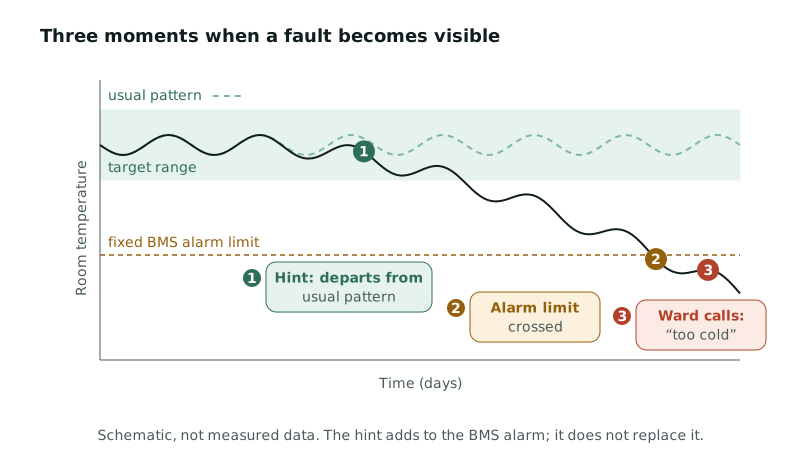 Figure 1: Three moments when a fault can become visible. Schematic, not measured data. Own illustration based on [5][8][9].
What a BMS alarm does, and what it does not
When a ventilation system fails, the BMS alarm is the right and important route. It exists for the estates team and, depending on the area, for safe operation. HTM 03-01 Part B expects local panels to show “On” and states such as “Set back”, “Off” or “Fault”, and requires an effective device to give an audible or visual warning of plant failure where this is needed for health or safety [9].
What a BMS alarm usually does not do is show the path towards the limit, the effect in the rooms, or the difference between a harmless consequential alarm and the first sign of a larger problem.
That is where an additional view helps: trends from room and plant data that show when a room or a unit behaves differently from usual. This view is a tool for maintenance planning. It is not a replacement for plant alarms and not a safety-related alarm system.
Care home heating failure
A heating failure in winter affects many rooms at once. In a hospital, a ward can move patients, combine bays or bring in temporary heaters. In a care home it is harder: residents live there, and many spend most of the day in their own room.
UK Health Security Agency guidance for healthcare professionals asks for plans to be in place to monitor room temperature, and for rooms, particularly living rooms and bedrooms, to be kept warm, explicitly including care, residential and nursing home settings [11]. Plans for cold weather should be agreed and distributed before 1 November each year, and staff should know the business continuity and cold weather plans for their setting [11].
A care home heating failure sometimes announces itself: flow temperatures fluctuate, rooms at the end of a circuit cool first, a pump runs unevenly. Where room temperatures are measured continuously, a room that cools faster than usual in the evening stands out before it is cold. For the on-call contractor, that can make the difference between a planned visit the next morning and a call at three in the morning.
From reactive to predictive maintenance for hospital HVAC
Maintenance terminology is set out in EN 13306 [10]. The International Electrotechnical Commission defines condition-based maintenance as preventive maintenance based on the assessment of physical condition, where the assessment may come from operator observation, scheduled checks or monitoring of system parameters [8]. Predictive maintenance builds on this by using repeated analysis of condition data to estimate when an intervention will be needed.
| Strategy | Trigger | Strength | Limit |
|---|---|---|---|
| Reactive (run to failure) | Breakdown or call from the ward | No planning effort | Emergency call-outs, root cause often unclear |
| Planned preventive | Interval, manufacturer schedule, regulation | Predictable, often mandatory | Cannot see what happens between visits |
| Condition-based | Assessment of physical condition, e.g. monitored parameters [8] | Intervene when needed | Needs reliable data and clear ownership |
| Predictive | Forecast from repeated analysis of condition data | Planning before failure | Needs long trends; models can be wrong |
Table 1: Maintenance strategies for building services. Own summary; terms after EN 13306 [10] and the IEC definition of condition-based maintenance [8].
Condition-based and predictive maintenance do not replace statutory inspections or planned maintenance. They add information about what happens in between.
HVAC fault detection and diagnostics: what the evidence shows
Automated FDD for buildings has been researched for decades. A review by Pacific Northwest National Laboratory summarises methods for commercial buildings published since 2004, sorts them into three groups and compares commercially available products [7].
There is also field evidence on outcomes. In a study covering 26 organisations, 550 buildings and about 97 million square feet, FDD users reported median savings of 8 per cent [6]. A related study of energy management and information systems (EMIS) and monitoring-based commissioning found that users who reported savings achieved a median of 7 per cent a year, with FDD systems showing higher savings and higher costs than simpler energy information systems [4]. Both studies concern US commercial buildings and rely on user-reported results. For hospitals they are an indication, not a promise.
What the studies show above all: value does not come from software alone, but from someone reviewing and acting on its findings. Without ownership, a fault list stays a list.
Which data shows drift early
Condition-based maintenance needs two perspectives: the room where a fault is felt and the plant where it starts.
| What the room shows | Possible cause in the plant | Data that helps |
|---|---|---|
| Room cools faster than usual in the evening | Falling heat output, pump, valve, hydraulic issue | Room temperature, flow and return temperatures |
| CO₂ rises higher than usual at the same occupancy | Less outdoor air: fan, damper, filter | Room CO₂, airflow, filter pressure drop |
| Temperature oscillates in a regular rhythm | Control loop hunting, sticking valve | Short-interval room temperature, control signals |
| Humidity stays high in summer | Cooling or dehumidification not effective | Room humidity, chilled water temperatures |
| Several rooms on one circuit change at once | Fault in central plant, not the room | Comparison of all rooms on the floor plan |
Table 2: Typical patterns and helpful data. Own compilation; diagnosis remains with the estates team or contractor.
The last row is often the most useful. When several rooms on the same circuit change together, the cause is rarely in the room, which saves a lot of searching during a call-out.
Hospital critical systems monitoring under HTM 03-01
Specialised ventilation in the NHS is governed by HTM 03-01. Part B requires critical ventilation systems to be inspected quarterly and verified at least annually [9]. It states that any rapid change in performance should be thoroughly investigated, as it is likely to be caused by a component or control software failure, and that trend analysis of annual verification results will highlight sudden changes [9]. It also refers to filter differential pressure being continuously monitored by a sensor connected to the BMS [9].
Continuous trends from rooms and plant extend that idea: they show changes not once a year but when they begin.
From call-out to planned work
A process that starts earlier does not need a new organisation, just a clear sequence.
- Bring data together. Room readings and BMS data in one view, room by room on the floor plan.
- Learn normal behaviour. How does each room behave on weekdays, weekends, day and night?
- Detect departures. Hints appear when a room or unit departs from its usual pattern, even before a limit is crossed.
- Check and schedule. Estates assess the hint and plan the work in normal hours.
- Record the outcome. What was the cause? The answer feeds back and improves the next hints.
The BMS alarm route stays exactly as it is, through your existing alarm handling and on-call arrangements.
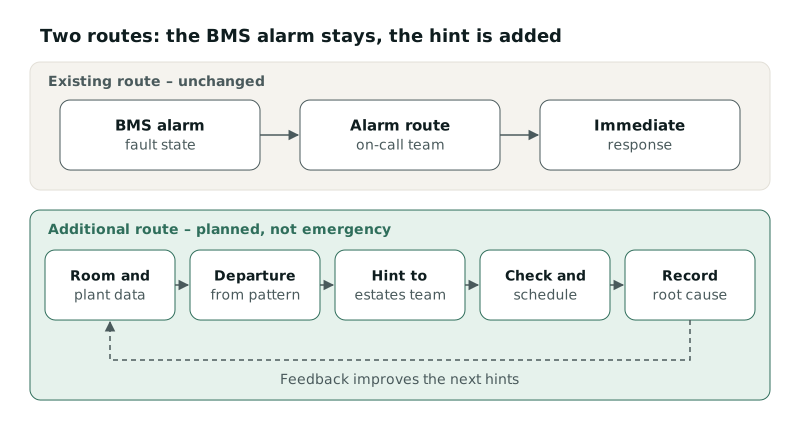 Figure 2: Two routes. The BMS alarm stays, the hint is added. Own illustration. Sources: [8][9][10].
Making on-call work lighter
For an on-call estates team, what matters is which call-outs can be avoided or moved into the working day. If a hint on Friday afternoon shows that a room at the end of a circuit cools in the evening, the cause can be checked before the weekend. If several rooms change at once, the engineer knows where to look before arriving. This does not replace on-call cover; it prepares it better.
Common mistakes
- Limits only. Monitoring that only alarms when it is too late for a planned fix.
- Alarm everything. Every small deviation becomes an alarm until nobody looks. A few well-founded hints work better.
- No owner. Hints arrive, but nobody is responsible for reviewing them.
- No room context. Plant values without the room make it hard to judge the impact of a deviation.
- The ward as the sensor. The ward stays the main fault reporter. That is not a failing of nursing staff; it shows the technology sees too little.
- No feedback. After a call-out, the root cause is not recorded, so the next search starts from scratch.
How Fact & Feeling helps
Fact & Feeling measures room conditions with its own sensors: CO₂, particulate matter, volatile organic compounds (VOC), temperature, humidity, light and sound. Devices connect over Wi-Fi, and the AI platform shows each room on the floor plan with live values, trends, issues and hints. It learns how each room usually behaves and shows when a room departs from that pattern.
For the topic of this article, that means:
- Room and plant side by side. Through data integration, BMS data, meters and existing sensors are brought in, so the state of the plant sits next to the room it serves. That adds room context to BMS alarm management without changing the alarm route.
- Hints before the limit. Monitoring shows departures from the usual pattern as hints on the platform, for the roles you choose: estates, ward managers, management. This is how HVAC fault detection and diagnostics work on the platform side.
- Understand first. A measuring phase under audit and analysis shows which rooms and units behave unusually before you decide on continuous, condition-based monitoring.
- For every 24/7 setting. In hospitals and clinics, where NHS backlog maintenance keeps older plant in service, the focus is ventilation and heating on the wards. In care homes, it is rooms that cool first when a care home heating failure is developing.
What Fact & Feeling is not: it is not a safety-related alarm system, not a replacement for your BMS alarms and alarm handling, not a monitor for medical devices and not a substitute for manufacturer or contractor maintenance. It does not diagnose plant; it shows anomalies that your estates team checks. We make no promises about uptime, failure rates or savings.
Limits and risks
- Safety stays with the BMS. Safety-related alarms, for example for ventilation in critical areas, run through the systems and on-call arrangements designed for them. A hint system is not built for that.
- Infection prevention. Whether a fault in theatres, critical care or isolation rooms has infection control implications is for your IPC team and Ventilation Safety Group to judge.
- Manufacturers and contractors. Statutory inspections, verification and planned maintenance stay with qualified contractors and authorised persons.
- Models can be wrong. Hints derived from trends can be wrong or miss something. They support the estates team’s decisions; they are not a diagnosis.
- Data protection and staff. Room data measures rooms, not people. Still, involve your data protection officer and staff representatives early.
- Health. If patients, residents or staff report symptoms they link to temperature or air quality, they should speak to a doctor.
Frequently asked questions
What is predictive maintenance for hospital HVAC?
Maintenance based on repeated analysis of condition data, such as room temperatures, airflows or filter pressure drops, to estimate when an intervention will be needed. It builds on condition-based maintenance [8] and complements planned maintenance.
How does HVAC fault detection and diagnostics work?
FDD software applies rules, models or data-driven methods to BMS and sensor data to flag faults such as stuck dampers, drifting sensors or hunting control loops [7]. Its value depends on someone reviewing and acting on the findings.
Does fault detection software save energy?
In US studies, FDD users reported median savings of 8 per cent [6]. Whether that transfers to a hospital depends on the plant, the data and who works through the findings.
What is the NHS backlog maintenance figure?
ERIC 2024/25 puts the estimated cost to eradicate backlog maintenance in the NHS in England at £15.9 billion [1].
What should a care home do about heating failure risk?
Have business continuity and cold weather plans agreed and distributed before 1 November, as UKHSA guidance asks [11], and know which rooms cool first. Continuous room temperatures help to spot a developing failure and to find affected rooms quickly.
Is a hint the same as a BMS alarm?
No. A BMS alarm reports a defined fault state through your alarm handling. A hint from room and plant data shows a departure from usual behaviour and supports maintenance planning. It does not replace the alarm.
Does condition-based maintenance replace HTM 03-01 verification?
No. Quarterly inspections and annual verification of critical ventilation remain [9]. Condition data adds information about what happens in between.
Who should receive the hints?
Usually the estates team or FM provider. Ward managers can benefit from a view of their rooms so they know a problem is already known. You decide this when monitoring is set up.
Sources
- NHS England Digital (2025): Estates Returns Information Collection, Summary page and dataset for ERIC 2024/25. https://digital.nhs.uk/data-and-information/publications/statistical/estates-returns-information-collection/summary-page-and-dataset-for-eric-2024-25
- BCIS (2025): Cost to clear NHS backlog maintenance nears £16 billion. https://www.bcis.co.uk/news/cost-to-clear-nhs-backlog-maintenance-nears-16-billion/
- Fozzard, K.; Kelly, E.; Issa, Z., The Health Foundation (2024): The NHS maintenance backlog: rising costs and falling investment. https://www.health.org.uk/reports-and-analysis/analysis/the-nhs-maintenance-backlog-rising-costs-and-falling-investment
- Kramer, H.; Lin, G.; Curtin, C.; Crowe, E.; Granderson, J. (2019): Building analytics and monitoring-based commissioning: industry practice, costs, and savings. Energy Efficiency. https://eta-publications.lbl.gov/publications/building-analytics-and-monitoring
- Crowe, E.; Chen, Y.; Reeve, H.; Yuill, D.; Ebrahimifakhar, A.; Chen, Y.; Troup, L.; Smith, A.; Granderson, J. (2023): Empirical Analysis of the Prevalence of HVAC Faults in Commercial Buildings. Science and Technology for the Built Environment, doi:10.1080/23744731.2023.2263324. https://eta-publications.lbl.gov/bibcite/reference/36129
- Lin, G.; Kramer, H.; Granderson, J. (2020): Building fault detection and diagnostics: Achieved savings, and methods to evaluate algorithm performance. Building and Environment 168. https://bies.lbl.gov/publications/building-fault-detection-and
- Kim, W.; Katipamula, S. (2018): A Review of Fault Detection and Diagnostics Methods for Building Systems. Science and Technology for the Built Environment 24(1), 3–21. https://www.pnnl.gov/publications/review-fault-detection-and-diagnostics-methods-building-systems
- International Electrotechnical Commission: Electropedia, IEV 192-06-07 “condition-based maintenance”. https://electropedia.org/iev/iev.nsf/IEVref_xref/en:192-06-07
- NHS England (2021): Health Technical Memorandum 03-01 – Specialised ventilation for healthcare premises, Part B. https://www.england.nhs.uk/wp-content/uploads/2021/05/HTM0301-PartB-accessible-F6.pdf
- DIN Media (2018): DIN EN 13306:2018-02 Maintenance – Maintenance terminology; Trilingual version EN 13306:2017. https://www.dinmedia.de/de/norm/din-en-13306/270274780
- UK Health Security Agency (2025): Supporting vulnerable people before and during cold weather: for healthcare professionals. https://www.gov.uk/guidance/supporting-vulnerable-people-before-and-during-cold-weather-for-healthcare-professionals