General information, not legal or infection prevention advice (status: October 2026). This article refers to guidance in England (HTM 03-01, HBN 00-09) and to German rules; requirements differ between countries and between facilities.
Hospital ventilation sits at the meeting point of two professions. Infection prevention and control (IPC) teams decide what is needed to protect patients and staff. Estates and facilities teams design, run and verify the plant. What often falls between them is something quite ordinary: a continuous view of how rooms are actually used and ventilated – at night, at weekends, during a heatwave, in the weeks between two inspections. This article looks at which room data can support the IPC team’s own work in hospitals and clinics, where that data says nothing at all, and why the judgement always stays with the IPC team.
Key points
- In England, HTM 03-01 expects the ventilation systems of a healthcare provider to be overseen by a Ventilation Safety Group that includes an IPC member [1]; critical systems are inspected quarterly and verified at least annually [2]. In Germany, DIN 1946-4 covers healthcare ventilation [10] and hospitals must set out their infection hygiene procedures in hygiene plans [12].
- Continuous room data – CO₂, temperature, relative humidity, particulate matter – shows how a room is ventilated and used over days and weeks. It does not show pathogens, infection risk or whether an IPC measure works.
- Useful applications include documenting how naturally ventilated rooms are actually aired, temperature and humidity in stores, humidity as an early pointer for mould checks, and CO₂ in waiting rooms and care homes.
- Room data is a tool for the IPC team, not a substitute for IPC policy, verification or microbiological sampling. Theatres, critical care and isolation rooms follow HTM 03-01 or DIN 1946-4 and the IPC team’s decisions, and stay outside any automatic control.
Hospital ventilation and infection prevention: who is responsible for what
Before looking at readings, it is worth being clear about roles. Room data only helps when everyone knows who interprets it and who acts.
In England, ventilation is governed through a Ventilation Safety Group. HTM 03-01 Part A states that the management of a healthcare provider’s ventilation systems should be overseen by a Ventilation Safety Group (VSG), and lists an IPC person among its members [1]. Part B, which covers existing systems, describes an Infection Prevention and Control Doctor or consultant microbiologist, nominated by management, who advises on the infection control policy and the microbiological performance of the systems [2]. It also requires that every critical healthcare ventilation system is inspected quarterly and verified at least annually, and that each system has a log, physical or electronic, including the records of its annual inspection and verification [2].
IPC is part of every capital project. Health Building Note 00-09 on infection control in the built environment says that the IPC team should be consulted throughout every stage of a capital project, and that ventilation and air-conditioning systems, including filtration where specialised ventilation is needed, belong on the list of items IPC reviews at sketch-plan stage [3].
In Germany, the rules sit in standards and in law. DIN 1946-4:2018-09 “Ventilation and air conditioning – Part 4: Ventilation in buildings and rooms of health care” sets technical and hygiene requirements for ventilation systems in examination and treatment areas, including qualification and acceptance [10]. Under § 23(5) of the Infection Protection Act (Infektionsschutzgesetz), hospitals, day clinics, rehabilitation and dialysis facilities and others must set out their internal infection hygiene procedures in hygiene plans [12]; § 35 does the same for inpatient and day care facilities for older people, people with disabilities or people in need of care, and for outpatient care services [13]. The Commission for Hospital Hygiene and Infection Prevention (KRINKO) at the Robert Koch Institute recommends, for example, rooms supplied with HEPA-filtered air for certain groups of severely immunosuppressed inpatients, and agreeing all building, renovation and demolition work near severely immunosuppressed patients with infection prevention staff from the planning phase onwards [4].
In the United States, the reference is ANSI/ASHRAE/ASHE Standard 170 “Ventilation of Health Care Facilities” [6].
Whatever the country, the pattern is the same: IPC decides what is hygienically appropriate, estates delivers it. Room data can give both a shared picture. The judgement stays with IPC.
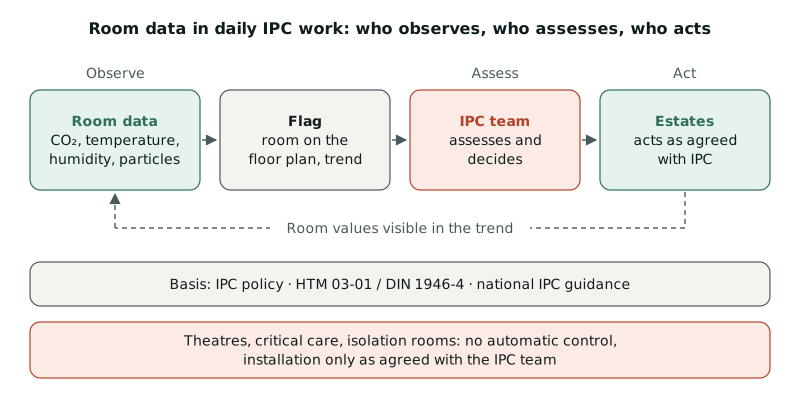 Figure 1: Room data provides observations, the IPC team assesses, estates acts – on the basis of the IPC policy and the applicable ventilation guidance. Own illustration. Sources: [1][2][3][10].
What happens between two inspections
Specialised ventilation is well documented. HTM 03-01 Part A expects the operation of ventilation systems to be monitored through a building management system (BMS) [1], and Part B sets out quarterly inspections and annual verification [2].
Most of a hospital, however, is not specialised ventilation. HTM 03-01 itself notes that in general areas and wards, odour control is the main reason for providing ventilation, and that natural ventilation is the preferred solution for a space where conditions allow [1]. Many single rooms, bays, day rooms, stores and waiting areas – and nearly every room in a care home – are ventilated through windows or simple extract fans. These rooms rarely have continuous measurement. What an IPC nurse sees on a walk-round is a snapshot: one room, one morning, one kind of weather, one level of occupancy. How the same room looks at 3 a.m. or on a humid August afternoon remains unknown.
That gap produces recurring questions:
- Is a four-bed bay actually aired the way the local IPC policy expects – including at night and at weekends?
- Does humidity in a bathroom, a store or a north-facing room regularly rise to levels where condensation on cold surfaces becomes likely?
- Do stores for consumables or sterile supplies stay within the temperature range the organisation has set for them during a heatwave?
- How stuffy does an outpatient waiting room get after an hour of clinic?
None of these is an infection question. They are questions about how rooms are operated. That is where room data can help. The World Health Organization’s ventilation roadmap, too, sets out how to assess ventilation and measure the relevant parameters in health care, non-residential and residential settings [7].
What room data can and cannot show
Room sensors measure properties of the air in a room. They do not measure whether pathogens are present in the air or on surfaces. This distinction is the core of this article.
CO₂ shows how well a room is ventilated for the number of people in it. ASHRAE notes that CO₂ can be used to check whether ventilation performs in line with existing standards, and that readings far above expected ranges may indicate that a system is not working properly [5]. The same brief is equally clear about the limits: indoor CO₂ does not provide an overall indication of indoor air quality, and it should not be used as a direct indicator of infection risk – not least because filtration and most other air-cleaning methods do not change CO₂ levels [5]. Germany’s Committee on Indoor Air Guide Values (Ausschuss für Innenraumrichtwerte) rates CO₂ below 1,000 ppm as hygienically unobjectionable, 1,000 to 2,000 ppm as conspicuous and above 2,000 ppm as unacceptable, in the sense of indoor air quality, and recommends more ventilation in the middle band [8].
Relative humidity is a pointer for mould checks. HTM 03-01 Part A advises keeping room air humidity below 70% to minimise risks associated with condensation and mould growth [1]. The German Environment Agency’s mould guideline puts the threshold for mould growth at roughly 70 to 80% relative humidity at the surface of a material over a longer period, names inadequate ventilation and heating among the causes [9], and regards indoor mould growth as a health risk [9]. A sensor in the middle of a room measures the humidity of the room air, not of a cold corner on an external wall. What it can show is which rooms are persistently damp, and when – and therefore where a closer look is worthwhile.
Temperature is the simplest and often the most useful reading. It shows whether rooms overheat, whether stores get warm in summer, and whether plant runs differently at night than planned.
Particulate matter shows particles, not spores. An optical particle sensor counts particles in size bands. Near building works it can show whether more dust reaches a corridor. It cannot tell whether those particles include fungal spores or other biological material. In its recommendation on immunosuppressed patients, KRINKO notes that nearby construction or demolition work can increase these patients’ exposure to infectious agents and recommends that such work is agreed with infection prevention staff [4]. Whether measurements help in that situation is for that team to decide.
Air changes per hour in hospitals: why a room sensor cannot measure them
Air changes per hour (ACH) are a design and verification parameter. They are design values taken from the applicable guidance and checked as part of validation and verification [1][2]. HTM 03-01 Part A gives 10 litres per second per person as the minimum ventilation requirement in the absence of other guidance [1]. A CO₂ sensor does not measure air changes. Under stable conditions, a rising or falling CO₂ curve says something about how ventilation relates to occupancy, and ASHRAE describes CO₂ as useful for checking whether ventilation performs as intended [5]. But it does not replace airflow measurement by a competent person.
Hospital room pressure monitoring and isolation rooms
Pressure differentials in isolation rooms and theatres, and the direction of airflow between clean and less clean areas, are safety-relevant. HBN 00-09 describes air flowing from the cleanest to sequentially less clean areas in specialist areas such as theatres [3]. HTM 03-01 expects the operation of ventilation systems to be monitored through the BMS [1]; how pressure regimes are monitored is part of the design and verification of those systems. General room sensors do not measure pressure. Where a hospital wants to see BMS data alongside room data for a joint overview, that is a question of data integration – but such a view is never a substitute for the alarms and indicators specified for the room.
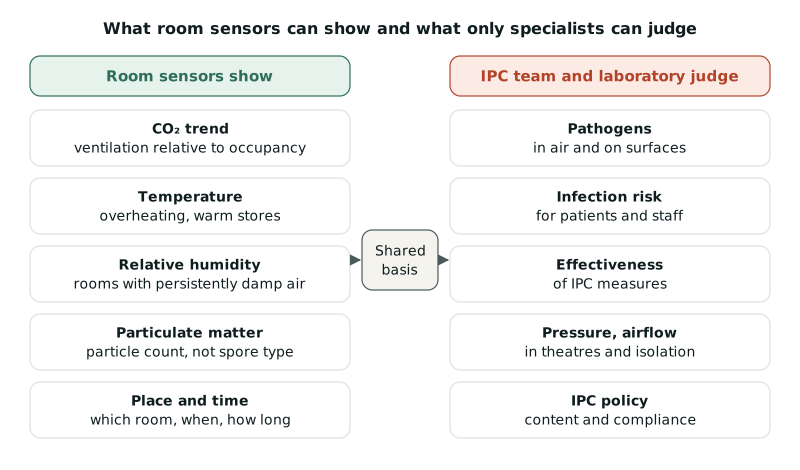 Figure 2: Room data describes the air in a room, not infection. Own illustration. Sources: [1][5][9].
Common mistakes with room data and infection prevention
Where room data and IPC meet, misunderstandings arise quickly. Some appear again and again.
Treating room data as evidence of hygiene. A chart of low CO₂ levels does not show that a room is clean or safe. It shows that it was well ventilated. Hygiene judgements need the IPC policy, audits and, where required, microbiological sampling.
Presenting a CO₂ traffic light as infection control. Since the pandemic, CO₂ displays have often been described as if they protect against transmission. ASHRAE explicitly advises against using CO₂ as a direct indicator of infection risk [5]. A display can prompt someone to open a window – no more.
Placing sensors in specialised areas without agreement. Theatres, critical care units and isolation rooms have their own rules for materials, cleaning and access. Any installation there needs the IPC team’s agreement first.
Saving energy without IPC. Ventilation in hospitals often runs around the clock, and wanting to save energy there is understandable. But shortening operating hours or reducing airflow can affect IPC requirements. In critical areas, any setback belongs with the VSG and the IPC team, and within the applicable guidance [1][10].
Reading values without room context. 1,200 ppm in a full meeting room is not the same as 1,200 ppm in a single room occupied overnight. Without room type, occupancy and time of day, readings are hard to interpret.
Collecting data without ownership. A dashboard nobody looks at helps nobody. Before measuring, agree who receives which flags and who decides.
Where room data can support the IPC team
The overview below sorts typical room types by which data can be useful there and what the IPC team can use it for. It is an orientation, not a requirement – what is measured in a facility is the facility’s decision.
| Room type | Possible room data | What the IPC team can use it for | What the data does not replace |
|---|---|---|---|
| Single rooms and bays with natural ventilation | CO₂, temperature, humidity | See how rooms are aired day and night; review local airing routines | IPC policy, audits, training |
| Stores for consumables or sterile supplies | Temperature, humidity | Document storage conditions, e.g. “dry” and “at room temperature” [11] | Manufacturer instructions, validated monitoring systems |
| Bathrooms, sluices, north-facing rooms | Humidity, temperature | Find persistently damp rooms for mould checks [1][9] | Building survey, remediation |
| Outpatient and GP waiting rooms | CO₂, temperature | Check whether the ventilation approach works in daily use | The practice’s IPC policy |
| Care home bedrooms | CO₂, humidity, temperature | Keep airing and overheating in view | Clinical and care judgement |
| Theatres, critical care, isolation (specialised ventilation) | Only as agreed; existing BMS data where available | Shared basis for discussion with estates | Validation, verification, pressure monitoring [1][2] |
| Corridors next to building works | Particulate matter | Additional view of dust levels if the IPC team wants it | IPC measures for building works [3][4] |
Table: Room data as a tool for the IPC team. Own compilation based on [1][2][3][4][9][11].
Humidity in hospitals and mould
Mould in a hospital or care home rarely appears overnight. Usually there are rooms where humidity stays high for weeks: bathrooms without effective extract, stores on external walls, rooms that are hardly heated. HTM 03-01 advises keeping room air humidity below 70% [1]. A German state health authority recommends, for new builds and refurbishments, a general target range of 20–24 °C and 45% ± 15% relative humidity, with a maximum of 60% in standard and intensive care patient rooms [14].
These values come from different documents with different scopes. Which limit an organisation uses is set with its IPC and estates teams. Room data then shows where and when that limit is exceeded – room by room, on the floor plan.
Temperature and humidity monitoring requirements in healthcare stores
The joint KRINKO and BfArM recommendation on reprocessing medical devices states that devices used sterile should be stored protected from dust, clean, dry and free from pests at room temperature [11]. It does not give a specific temperature at that point. Many organisations set their own ranges.
Continuous temperature and humidity readings in a store can give the IPC team simple documentation: how warm did the room get in July? Were there days with unusually high humidity? The boundary matters: room sensors monitor the room, not the medical devices or medicines in it. They do not replace validated monitoring where that is required, for example for medicine fridges.
CO₂ monitoring in care homes
In a care home, the bedroom is the resident’s home. Some residents prefer to keep the window shut, others like to air the room themselves. CO₂ and temperature trends can show which rooms get very little air exchange overnight and which cool down sharply after airing. Staff can use that to develop airing routines that fit the people who live there. Deciding what is appropriate stays with the home and its IPC lead.
Preparing an audit or walk-round
Room data can help prepare an IPC audit or estates walk-round. Instead of treating every room the same, the team can see in advance which rooms showed unusual patterns in recent weeks: persistently high humidity, very high CO₂ at night, warm stores. The walk-round itself remains essential. It simply starts from a more targeted list.
How Fact & Feeling helps
Fact & Feeling measures room conditions with sensors for CO₂, particulate matter, volatile organic compounds, temperature, humidity, light and sound. The devices connect via Wi-Fi; the platform shows rooms on the floor plan with live values, trends, issues and hints. Where a hospital already has data in its building management system, it can be brought in through data integration – for example to see BMS readings alongside room data, never as a replacement for the room’s own pressure monitoring.
For IPC work, this means:
- A measuring phase first: In audit and analysis, selected rooms are measured for a limited period. Which rooms, and which target values apply per room type, is agreed with nursing, IPC and estates.
- Humidity and temperature over time: With monitoring around the clock, the devices stay; trends over days, weeks and months and regular reports per ward or area are available.
- Rooms in context: Every reading is linked to a room on the floor plan, so the team sees not only a number but the room, its use and the time behind it. More on the devices is on platform and devices.
- No personal data: The sensors measure the environment, not people.
What Fact & Feeling deliberately does not do: we do not assess hygiene, give statements on compliance with IPC requirements, measure pathogens, monitor medical devices, or replace IPC specialists, verification or safety-related alarm systems. Theatres, critical care and isolation rooms stay outside any automatic control; there, the applicable ventilation guidance and your IPC team decide.
How this fits other settings is described on the pages for care homes, where CO₂ monitoring and airing are part of daily life, and for medical practices with their own temperature and humidity questions.
Limits and risks
Room data can be useful. It can also create false reassurance. So, plainly:
- No statement about infection. Neither CO₂ nor particles, temperature nor humidity says anything about whether pathogens are present or whether an IPC measure works [5]. IPC questions belong with IPC specialists – the IPC nurse, the infection control doctor, the consultant microbiologist.
- No substitute for verification. Validation, annual verification and inspection of ventilation systems remain the job of competent persons under HTM 03-01 or DIN 1946-4 [2][10].
- No alarm for safety-critical values. Pressure in isolation rooms, airflow direction in theatres and medicine fridge temperatures belong in the systems specified for them.
- Sensors measure at one point. A sensor shows the air where it is installed. It does not capture cold corners, surface moisture or airflow at the bedside.
- Setbacks only with IPC. Any change to operating hours or airflow in critical areas needs the agreement of the IPC team and the Ventilation Safety Group and must stay within the guidance.
- Health concerns belong with a doctor. If patients, residents or staff have symptoms they connect with the indoor environment, the right route is a medical assessment and, for staff, occupational health.
- Legal questions need specialists. What your IPC policy or hygiene plan must contain is a question for your IPC team, the competent authority and, where needed, legal advice.
Frequently asked questions
What is HTM 03-01?
Health Technical Memorandum 03-01 is NHS England’s guidance on specialised ventilation for healthcare premises. Part A covers design and validation and applies to new installations and major refurbishments [1]; Part B covers the management, operation, maintenance and routine testing of existing systems [2].
How many air changes per hour does a hospital room need?
That depends on the room type and the guidance that applies. In the absence of other guidance, HTM 03-01 gives a minimum of 10 litres per second per person [1]; specialised rooms are designed to the values in the applicable guidance. Ventilation performance is checked during validation and verification [2], not by room sensors.
What humidity should a hospital room have?
HTM 03-01 advises keeping room air humidity below 70% to minimise condensation and mould growth [1]. A German state authority recommends 45% ± 15% and a maximum of 60% in patient rooms for new builds and refurbishments [14]. Your IPC and estates teams set the values for your organisation.
Can CO₂ monitoring show infection risk?
No. ASHRAE states that CO₂ should not be used as a direct indicator of infection risk, partly because filtration and air cleaning do not change CO₂ levels [5]. CO₂ shows whether ventilation is adequate for occupancy.
Do isolation rooms need pressure monitoring?
Isolation rooms and theatres rely on controlled pressure and airflow direction [1][3]. How that is monitored is set in the design and verification of the system, and HTM 03-01 expects ventilation operation to be monitored through the BMS [1]. General room sensors do not measure pressure and are not a substitute.
What does HBN 00-09 say about ventilation?
HBN 00-09 asks for the IPC team to be consulted throughout every stage of a capital project and lists ventilation and air-conditioning, including filtration for specialised ventilation, among the items to review [3].
Is CO₂ monitoring useful in care homes?
It can show how well bedrooms and day rooms are aired relative to occupancy, especially at night. How often to air, and how to balance fresh air with residents’ comfort, is decided by the home.
Is Fact & Feeling a medical device or an IPC system?
No. Fact & Feeling measures room conditions for building operations. It makes no statements on hygiene, infection or patient health and does not monitor medical devices.
Sources
- NHS England (2021): Health Technical Memorandum 03-01: Specialised ventilation for healthcare premises, Part A. https://www.england.nhs.uk/wp-content/uploads/2021/05/HTM0301-PartA-accessible-F6.pdf
- NHS England (2021): Health Technical Memorandum 03-01, Part B: The management, operation, maintenance and routine testing of existing healthcare ventilation systems. https://www.england.nhs.uk/wp-content/uploads/2021/05/HTM0301-PartB-accessible-F6.pdf
- Department of Health (2013): Health Building Note 00-09: Infection control in the built environment. https://www.england.nhs.uk/wp-content/uploads/2021/05/HBN_00-09_infection_control.pdf
- KRINKO (2022): Infection prevention requirements for the medical care of immunosuppressed patients (English translation; the German original in Bundesgesundheitsblatt 2021;64:232–264 is binding). GMS Hygiene and Infection Control 17:Doc07. https://pmc.ncbi.nlm.nih.gov/articles/PMC9174886
- ASHRAE (2023): Indoor Carbon Dioxide, Ventilation and Indoor Air Quality. https://www.ashrae.org/file%20library/about/government%20affairs/public%20policy%20resources/briefs/indoor-carbon-dioxide-ventilation-and-indoor-air-quality_2023.pdf
- ASHRAE/ASHE (2021): ANSI/ASHRAE/ASHE Standard 170-2021 Ventilation of Health Care Facilities. https://shop.iccsafe.org/ansi-ashrae-ashe-standard-170-2021-ventilation-of-health-care-facilities.html
- WHO (2021): Roadmap to improve and ensure good indoor ventilation in the context of COVID-19. https://www.who.int/publications/i/item/9789240021280
- Umweltbundesamt, Ausschuss für Innenraumrichtwerte (2008, page as of 2022): Hygienische Leitwerte für die Innenraumluft (carbon dioxide). https://www.umweltbundesamt.de/system/files/medien/4031/bilder/dateien/hygienische_leitwerte_0.pdf
- Umweltbundesamt (2024): Zur Vorbeugung, Erfassung und Sanierung von Schimmelbefall in Gebäuden – Leitfaden (mould guideline). https://www.umweltbundesamt.de/sites/default/files/medien/479/publikationen/240513_uba_fb_schimmelleitfaden.pdf
- DIN (2018): DIN 1946-4:2018-09 Ventilation and air conditioning – Part 4: Ventilation in buildings and rooms of health care (amended by DIN 1946-4/A1:2025-11). https://www.dinmedia.de/de/norm/din-1946-4/294438653
- KRINKO and BfArM (2012): Anforderungen an die Hygiene bei der Aufbereitung von Medizinprodukten. Bundesgesundheitsblatt 55:1244–1310. https://edoc.rki.de/bitstream/handle/176904/12400/Medprod_Rili_2012.pdf
- Federal Ministry of Justice (2026): Infektionsschutzgesetz, § 23. https://www.gesetze-im-internet.de/ifsg/__23.html
- Federal Ministry of Justice (2026): Infektionsschutzgesetz, § 35. https://www.gesetze-im-internet.de/ifsg/__35.html
- Landesamt für Gesundheit und Soziales Mecklenburg-Vorpommern (2024): Bauanforderungen und funktionelle Empfehlungen aus der Sicht der Hygiene für den Neubau und die Sanierung von Krankenhäusern und Universitätskliniken in M-V. https://www.lagus.mv-regierung.de/serviceassistent/download?id=1670233