General information, not legal advice (status: October 2026). This article covers EU, UK and German rules; check the regulations that apply to your organisation.
ISO 50001 certification shows that an organisation runs an energy management system that meets the international standard. For hospital groups, it is moving from a voluntary badge to a compliance route. The EU’s revised Energy Efficiency Directive requires large energy users to run a certified energy management system, the UK accepts ISO 50001 as a way to meet ESOS, and Germany already requires one above 7.5 GWh a year [3][4][6]. This guide explains what an energy management system in a hospital looks like, what certification involves, how long it takes and where data makes the difference. It is written for estates and facilities directors, energy managers and the finance leads who sign off the work.
In short
- ISO 50001 certification is issued by an accredited certification body after a two-stage audit; the certificate runs for three years, with yearly surveillance audits [8][9].
- When it is required: under EU Directive 2023/1791, enterprises using more than 85 TJ (about 23.6 GWh) a year need a certified energy management system by 11 October 2027 [3]. In the UK, ISO 50001 is one route to ESOS compliance [4]. In Germany, the threshold is 7.5 GWh today [6].
- The standard is about management, not software: clear responsibility, an energy review, significant energy uses, energy performance indicators and a baseline [1][7].
- Fair indicators matter: raw consumption falls in a mild winter. ISO 50001 expects weather and activity to be normalised before claiming improvement [7].
- Measure first: a metering plan that can separate ventilation, heat, steam and cooling is the backbone of a credible system.
Why hospitals are being pushed towards ISO 50001
Hospitals run around the clock. They heat, cool and ventilate large buildings, produce steam for sterilisation and run kitchens and laundries. That makes most hospital operators large energy users, and the rules on energy management now follow consumption rather than sector.
| Jurisdiction | Rule | Who | What ISO 50001 does |
|---|---|---|---|
| EU | Energy Efficiency Directive (EU) 2023/1791, Article 11 | Enterprises above 85 TJ (≈ 23.6 GWh) a year; energy audits above 10 TJ (≈ 2.8 GWh) | A certified energy management system is required by 11 October 2027 [3] |
| UK | Energy Savings Opportunity Scheme (ESOS), phase 4 | Large undertakings: 250+ employees, or turnover above £44m and balance sheet above £38m; public bodies excluded | A recognised compliance route; notification due 5 December 2027 [4][5] |
| Germany | Energy Efficiency Act (EnEfG), § 8 | Enterprises above 7.5 GWh a year, including non-profit hospital operators | ISO 50001 or EMAS required [6] |
Table 1: Where ISO 50001 meets regulation. Conversions: 1 GWh = 3.6 TJ (own calculation). Status October 2026.
For NHS bodies, ESOS excludes public bodies that meet the contracting-authority tests, so whether a trust is in scope is a question to check against the guidance [4]. Independent hospital groups and care home operators that count as large undertakings are in scope [4][5]. In Germany, a 2026 bill would raise the threshold to 23.6 GWh in line with the directive; it has not been adopted as of October 2026 [11]. The German duties in full are explained in our guide to the German Energy Efficiency Act and hospitals.
What an energy management system in a hospital looks like
ISO 50001:2018 follows the plan–do–check–act cycle and applies to organisations of any type and size [1]. A 2024 amendment added climate action changes [2]. The work that matters most:
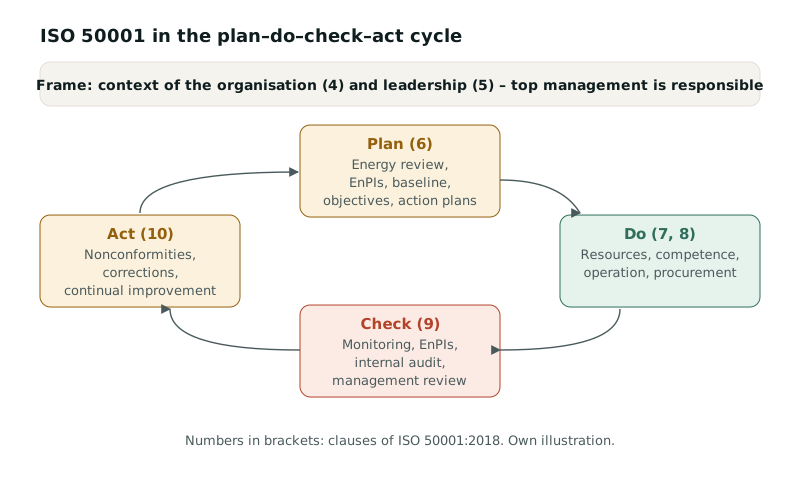 Figure 1: ISO 50001 in the plan–do–check–act cycle. Own illustration based on [1][8].
- Energy review: where energy goes and what drives it. In a hospital the usual suspects are ventilation and air handling, heat and steam generation, chillers, sterile services, catering and laundry.
- Significant energy uses: the areas with high consumption or large potential. Each needs its own energy performance indicator [7].
- Energy performance indicators (EnPIs) and energy baseline (EnB): the indicator measures performance, the baseline is the reference period. Improvement means the current value beats the normalised baseline [7].
- Organisation-wide indicator: besides indicators per significant energy use, the organisation needs one for the whole estate to show the overall trend [7].
Worked example: why indicators must be normalised
Worked example (our own calculation with assumed figures, not measured data): a hospital uses 12.0 GWh of heat in its baseline year with 3,300 heating degree days. 4.0 GWh is base load (hot water, steam, sterilisation) and 8.0 GWh depends on the weather. The next winter is milder, with 3,000 degree days, and heat use is 11.0 GWh.
- Unadjusted, that looks like an 8.3 % saving.
- Adjusted for weather, the expected use is 4.0 + 8.0 × 3,000 / 3,300 ≈ 11.3 GWh.
- The real improvement is about 0.3 GWh, or roughly 2.4 %.
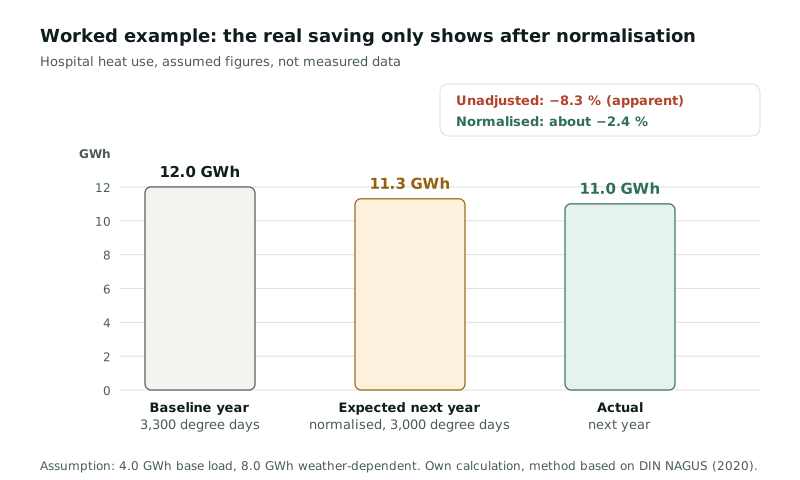 Figure 2: Worked example with assumed figures. Own calculation, method based on [7].
Assumptions: the weather-dependent part scales linearly with degree days, occupancy is unchanged and there are no building changes. Regression models with several variables are more accurate, and simple ratios such as kWh per bed often miss the base load [7].
How ISO 50001 certification works
Certification is carried out by an accredited certification body [6][9]:
- Stage 1 audit: readiness – documentation, scope, and whether an internal audit and management review have taken place [8].
- Stage 2 audit: on site – whether every requirement is implemented, including visits to energy-relevant areas [8].
- Certificate: valid for three years, with annual surveillance audits and a full recertification every three years [9].
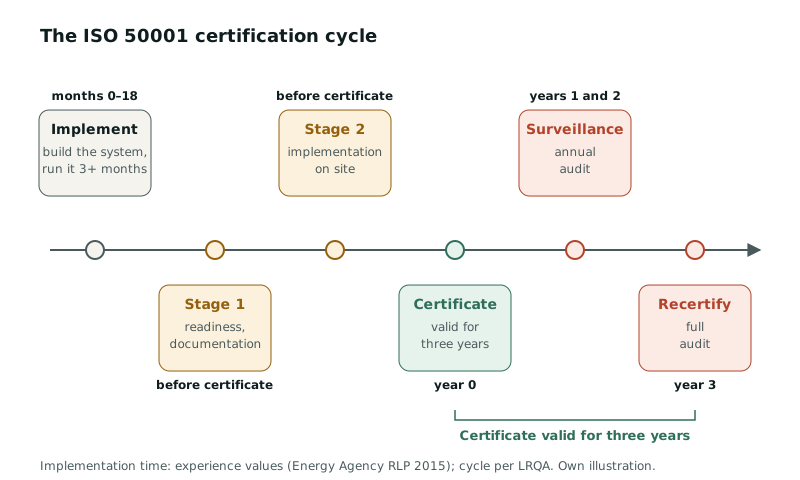 Figure 3: The ISO 50001 certification cycle. Own illustration based on [8][9].
Improvement in energy performance does not have to appear every year, but it must be demonstrable by recertification [7].
How long it takes
Experience figures from a German certification body, published by the Rhineland-Palatinate energy agency, put implementation for a single site with more than 500 employees at about 4–8 months where another management system already exists and 6–18 months without; each additional site adds roughly 2–4 months [8]. A multi-site hospital group should plan for more than a year. A certification body notes that the system usually needs to have run for at least three months before the certification audit [9].
ISO 50001, EMAS or an energy audit?
| ISO 50001 | EMAS | Energy audit (EN 16247-1 / ESOS) | |
|---|---|---|---|
| What it is | Energy management system | EU environmental management scheme; energy is one aspect | A one-off assessment, repeated every four years |
| Checked by | Accredited certification body | Environmental verifier; entry in the EMAS register [10] | Energy auditor or lead assessor |
| Public output | Certificate | Validated environmental statement, updated yearly [10] | None |
| Fits when | Energy is the priority | A wider environmental or sustainability system is planned | Consumption is below the management system threshold |
Table 2: Comparison. Sources: [3][4][6][10].
Common mistakes
- A certificate without a metering plan. With only main meters and annual bills, significant energy uses cannot be separated and savings cannot be proven.
- Raw consumption as the indicator. Weather and activity drive hospital energy use; without normalisation, results are noise [7].
- An energy manager without a mandate. The standard puts responsibility with top management [1]. Without board backing, the system becomes a binder on a shelf.
- Forgetting the wards. A setback that saves energy but leaves patient rooms cold or therapy rooms stuffy will be reversed. Room conditions belong in the check of every measure.
- Bypassing infection prevention. Changes to ventilation in theatres, critical care or isolation rooms need the infection prevention team and the applicable ventilation guidance.
How Fact & Feeling supports an energy management system
Fact & Feeling measures room conditions (CO₂, particulate matter, VOCs, temperature, humidity, light and sound) and brings meters, the building management system and existing sensors onto one platform through data integration, room by room and site by site. For an ISO 50001 system, that means consumption can be assigned to areas, indicators can be compared with drivers such as occupancy and weather, and audit and analysis provides data before and after a measure. The platform also shows whether patient rooms and clinical spaces stay within the agreed range. Our room sensors measure the environment, not people.
Fact & Feeling is not an energy management system in the sense of the standard, not a certification body, not an energy audit and not legal or energy advice. It provides data your energy team, advisers and auditors can use. More on hospitals and clinics.
Risks and limits
- Legal scope: whether your organisation is in scope of ESOS, the EED or the EnEfG is a legal question; check the official guidance or take advice [4][6].
- Certification: only accredited bodies issue ISO 50001 certificates; EMAS is validated by environmental verifiers [9][10].
- Infection prevention: energy measures on ventilation in critical areas only with the infection prevention team.
- Figures: the timeframes are experience values from a certification body, not a promise [8]. Fact & Feeling does not promise savings.
- Changing rules: thresholds and dates may change as the EED is transposed [3][11].
ISO 50001 certification: quick answers
Is ISO 50001 certification mandatory for hospitals?
It depends on consumption and jurisdiction. The EU directive requires a certified system above 85 TJ a year by October 2027 [3]; Germany requires ISO 50001 or EMAS above 7.5 GWh today [6]; in the UK it is one route to ESOS compliance for large undertakings [4].
How long does ISO 50001 certification take?
For a large single site, about 4–18 months to implement, depending on whether another management system already exists; more for multi-site groups [8].
How long is an ISO 50001 certificate valid?
Three years, with surveillance audits every year and recertification at the end of the cycle [9].
Can ISO 50001 be used for ESOS compliance?
Yes. ISO 50001 certification remains a recognised ESOS route; display energy certificates and Green Deal assessments are no longer accepted in phase 4 [4][5].
What is the difference between ISO 50001 and EMAS?
ISO 50001 focuses on energy and is certified. EMAS is an EU environmental management scheme with a validated, public environmental statement and registration [10].
Sources
- ISO (2018): ISO 50001:2018 Energy management systems – Requirements with guidance for use. https://www.iso.org/standard/69426.html
- ISO (2024): ISO 50001:2018/Amd 1:2024 – Climate action changes. https://www.iso.org/standard/88430.html
- Directive (EU) 2023/1791 on energy efficiency, Article 11 Energy management systems and energy audits (text via gesetze.legal). https://gesetze.legal/eu/rl_2023_1791_eu/11
- GOV.UK / Environment Agency: How to comply with the Energy Savings Opportunity Scheme (ESOS) phase 4. https://www.gov.uk/government/publications/comply-with-the-energy-savings-opportunity-scheme-esos-phase-4/how-to-comply-with-the-energy-savings-opportunity-scheme-esos-phase-4
- Burges Salmon (4 September 2026): ESOS phase 4 guidance published – what businesses need to know. https://www.burges-salmon.com/articles/102o07v/esos-phase-4-guidance-published-what-businesses-need-to-know
- German Federal Office for Economic Affairs and Export Control (BAFA) (2024): Merkblatt für das Energieeffizienzgesetz (EnEfG), version 1.2 (copy at IHK Arnsberg). https://ihk-arnsberg.de/upload/ea_merkblatt_energieefffizienzgesetz_47381.pdf
- DIN Standards Committee Principles of Environmental Protection (NAGUS) (2020): Determining and demonstrating improvement in energy performance under ISO 50001:2018 (published by the German Environment Agency). https://www.umweltbundesamt.de/system/files/medien/1/dokumente/exkurs_-_bestimmung_und_darstellung_der_verbesserung_der_energiebezogenen_leistung.pdf
- Energy Agency Rhineland-Palatinate (2015): Step by step to an energy management system under ISO 50001 (fact sheet, timeframes based on GUTcert experience). https://energieagentur.rlp.de/fileadmin/user_upload/20150924_fp_schritt_fuer_schritt_ISO_50001.pdf
- LRQA: ISO 50001 certification – process, validity and surveillance audits. https://www.lrqa.com/de-de/iso-50001/
- State Agency for Nature, Environment and Consumer Protection NRW (2019): EMAS fact sheet. https://www.lanuk.nrw.de/fileadmin/lanuv/nachhaltige_verwaltung/Ma%c3%9fnahmenblatt-EMAS_LANUV_NVdZ.pdf
- German Bundestag (2026): Public hearing on the Energy Efficiency Directive bill (printed paper 21/8027), 5 October 2026. https://www.bundestag.de/dokumente/textarchiv/2026/kw41-pa-wirtschaft-energieeffizienzrichtlinie-1218082