General information, not legal advice (status: October 2026). This article draws on EU, UK and German sources; check the rules that apply to your buildings.
Smart heating controls promise to heat each room only when and as much as it is needed. In care homes and hospitals that promise meets a hard constraint: many rooms are someone’s bedroom or home around the clock, while others – clinics, offices, day rooms – sit empty for hours. This guide explains what room-by-room heating control can and cannot do, what the research actually shows about savings, what EU rules now require, and how estates and facilities teams can use controls without making residents or patients cold. It is written for estates managers, care home operators and energy managers. For the wider picture of ventilation and heating in healthcare buildings, see our guide to hospital ventilation: saving energy within hygiene limits.
In short
- Smart heating controls range from thermostatic radiator valves (TRVs) to networked room controllers linked to the building management system (BMS).
- The evidence is mixed. A long-term field study found 7.1–23.3 % savings from TRVs, depending on whether hydraulic balancing was done as well [3]. A review for the UK government found little robust evidence that controls on their own save energy in practice, mainly because people do not use or override the features [2].
- EU rule: new buildings, and existing buildings when the heat generator is replaced, must have self-regulating devices to control the temperature in each room or zone where technically and economically feasible [1].
- Rooms differ: clinics, offices and day rooms can follow a timetable; residents’ rooms and patient rooms need room for individual preference.
- Commission, then check. Controls only work if they are set up, explained to staff and checked against real room temperatures.
Why heating control is hard in care settings
A care home is a home. Residents spend much of the day in their rooms, often feel the cold more than staff, and should have a say in the temperature. Hospitals add 24/7 wards next to outpatient clinics that close in the evening. One central setting cannot fit all of these rooms.
Without room-by-room heating control, the usual pattern follows: some rooms overheat and windows are opened, others stay cold and the flow temperature is raised for everyone. Typical causes are radiators that were never balanced, valves without presetting, time schedules that ignore opening hours and controllers that heat against open windows [4].
What the evidence says about savings
| Evidence | What it found | Caveat |
|---|---|---|
| Cholewa et al. (2017), nine multi-family buildings, long-term field data | 7.1–23.3 % lower heating use, depending on TRVs alone, balancing alone, or both together [3] | Residential buildings in Poland |
| BEIS international evidence review (2017) | Lack of robust evidence for zonal control; programmable thermostats often saved little in practice; many users did not use or overrode energy-saving features [2] | Mostly US and residential studies |
Table 1: Two views of the evidence. Sources: [2][3].
The lesson for care homes and hospitals is not that controls are useless. It is that the result depends on the package – balancing, set-up, sensible time profiles and staff who understand them – and that the effect has to be measured, not assumed.
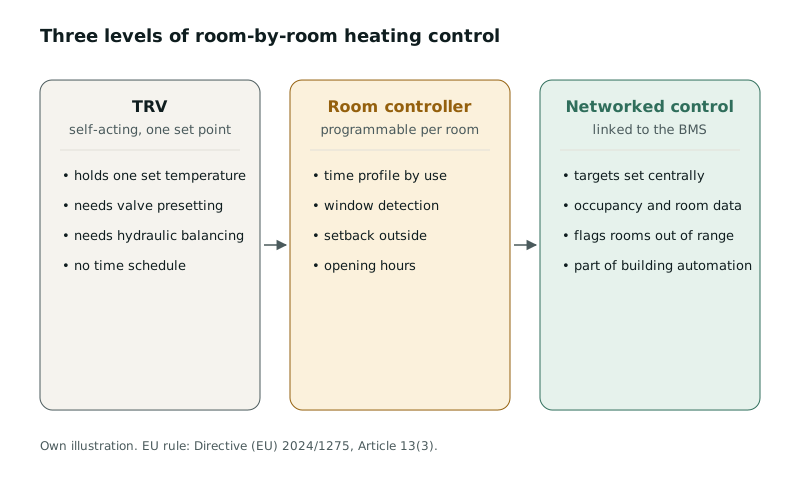 Figure 1: Three levels of room-by-room heating control. Own illustration.
Rules that push towards room-by-room control
- EU: Article 13(3) of the recast Energy Performance of Buildings Directive requires self-regulating devices for the separate regulation of the temperature in each room – or, where justified, each zone – in new buildings, and in existing buildings when heat generators are replaced, where technically and economically feasible, together with hydronic balancing where appropriate [1].
- Germany: the building law requires automatic room-by-room temperature control for water-based heating and a retrofit in existing buildings without it. Non-residential buildings may control rooms of the same type in groups; care homes count as residential buildings, so that group option does not apply to them [5][6].
- Workplaces: where staff work, minimum temperatures for workrooms apply; in Germany, for example, +20 °C for light seated work [7].
Common mistakes
- New valves, no balancing. Without hydraulic balancing, radiators near the pump still get too much water and distant rooms too little [4].
- One schedule for every room. Residents’ rooms get the same setback as the office.
- Controls nobody understands. If staff cannot see or adjust the settings, they override them – the main reason controls fail in the evidence review [2].
- No check afterwards. Without room temperature data, nobody knows whether rooms stay in the agreed range.
- Treating critical areas like any other room. In theatres, critical care or isolation rooms, temperature is tied to specialised ventilation; changes need the infection prevention team.
Which rooms, which strategy
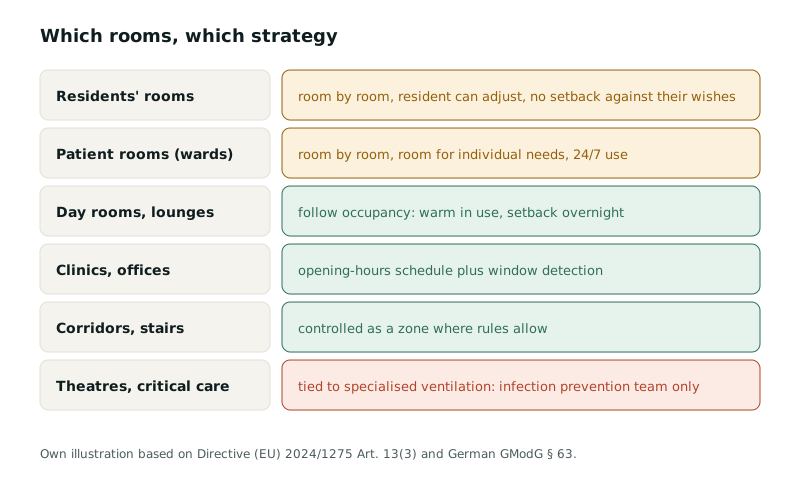 Figure 2: Room types and control strategies. Own illustration based on [1][5][6].
Worked example: a care home day lounge
Worked example (own calculation with assumed figures, not measured data): a day lounge is used every day from 08:00 to 20:00, so 84 of 168 hours a week. Outside these hours it is set back from 21 °C to 18 °C. The average outdoor temperature during the heating season is assumed to be 5 °C (41 °F).
- Without setback: 16 K × 168 h = 2,688 kelvin-hours a week.
- With setback: 16 K × 84 h + 13 K × 84 h = 2,436 kelvin-hours.
- On paper, the lounge’s heat demand falls by about 9.4 %.
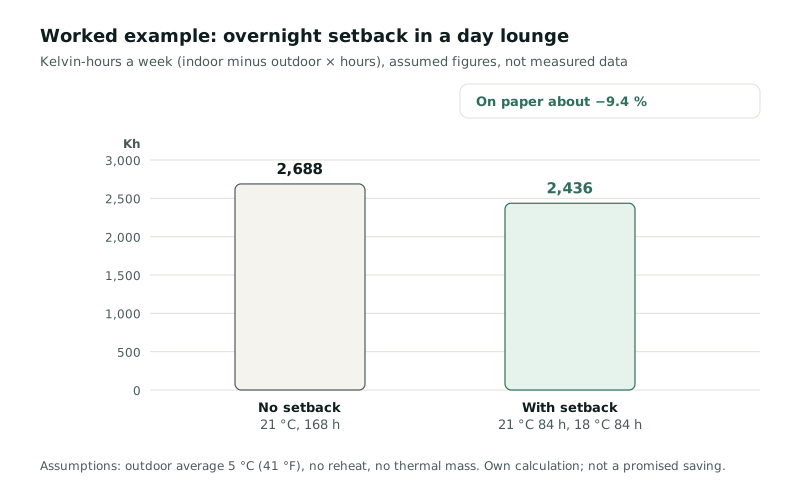 Figure 3: Worked example with assumed figures. Own calculation.
Assumptions and limits: heat loss proportional to the indoor–outdoor difference, no thermal mass, no morning reheat, no internal gains. Real savings are smaller because the building cools slowly and has to be reheated. Residents’ rooms are deliberately not part of this example.
A practical sequence for heating optimisation
- Survey: radiators, valves, circuits, pumps and existing controls.
- Balance the system: heat load per room, flow rates, valve presetting, pump and heating curve [4].
- Group rooms by use: residents’ and patient rooms, day rooms, clinics, offices, corridors.
- Set and document profiles, and show staff how to adjust them.
- Measure before and after: room temperatures and consumption.
How Fact & Feeling helps
Fact & Feeling measures temperature, humidity, CO₂, particulate matter, VOCs, light and sound room by room and brings in BMS and meter data through data integration. For smart heating controls, that means you see which rooms run too warm or too cold before you change anything, and afterwards whether schedules match real use and rooms stay in the agreed range. Our automation service helps tune controls against that room data. Our room sensors measure the environment, not people.
Fact & Feeling is not a heating contractor, does not replace hydraulic balancing or design, is not an alarm or safety system and is not legal advice. More on care homes and hospitals.
Risks and limits
- Comfort first: residents and patients need a say; controls should allow individual adjustment.
- Contractors: balancing, valves and controllers belong with qualified heating engineers.
- Infection prevention: in critical areas, temperature changes only with the infection prevention team and the ventilation engineer.
- Evidence: most studies come from homes, not care settings [2][3]; the worked example is not a promise. Fact & Feeling does not promise savings.
- Rules: EU and national requirements differ; check local building regulations.
Smart heating controls: quick answers
Do smart heating controls save energy in care homes?
They can, but the evidence is mixed. A field study found 7.1–23.3 % savings from TRVs combined with balancing [3], while a UK government review found little robust evidence that controls alone save energy, mostly because they are not used as intended [2].
What is room-by-room heating control?
Each room – or each zone of similar rooms – has its own automatic temperature control, from a TRV to a networked room controller. EU rules require it for new buildings and when heat generators are replaced, where feasible [1].
Should residents’ rooms be set back at night?
Not against the resident’s wishes. A care home is their home; controls should allow individual adjustment, while day rooms, offices and corridors can follow occupancy.
How does heating control relate to a building management system?
A networked room controller can be part of the BMS, which sets targets centrally, uses occupancy data and flags rooms that drift out of range.
Is hydraulic balancing needed before installing smart controls?
Usually yes. Without balancing, some radiators get too much flow and others too little, which limits what any controller can do [4].
Sources
- European Union (2024): Directive (EU) 2024/1275 on the energy performance of buildings (recast), Article 13(3). https://eur-lex.europa.eu/eli/dir/2024/1275/oj
- Oliveira, S. et al. (University of the West of England and BSRIA) for the Department for Business, Energy and Industrial Strategy (2017): Heating Controls – International Evidence Base and Policy Experiences. https://assets.publishing.service.gov.uk/government/uploads/system/uploads/attachment_data/file/650840/heating-controls-international-evidence.pdf
- Cholewa, T.; Siuta-Olcha, A.; Balaras, C. A. (2017): Actual energy savings from the use of thermostatic radiator valves in residential buildings – Long term field evaluation. Energy and Buildings 151, 487–493. https://pub.pollub.pl/publication/6577/
- Verbraucherzentrale (status 10 Nov 2025): Hydraulischer Abgleich – So wird Ihre Heizung effizienter (hydraulic balancing explained, in German). https://www.verbraucherzentrale.de/wissen/energie/heizen-und-warmwasser/hydraulischer-abgleich-so-wird-ihre-heizung-effizienter-30110
- Federal Ministry of Justice (Germany): Gebäudemodernisierungsgesetz (GModG), § 63 Raumweise Regelung der Raumtemperatur. https://www.gesetze-im-internet.de/geg/__63.html
- Federal Ministry of Justice (Germany): Gebäudemodernisierungsgesetz (GModG), § 3 Begriffsbestimmungen (para. 1 no. 33 residential buildings). https://www.gesetze-im-internet.de/geg/__3.html
- Federal Institute for Occupational Safety and Health (BAuA): Technical Rule for Workplaces ASR A3.5 Room temperature (2010 edition, last amended 2022). https://www.baua.de/DE/Angebote/Regelwerk/ASR/ASR-A3-5